‘Compacts with Africa’: An Effective Lever for Private Investment?
Megatrends spotlight 81, 31.08.2026
The G20’s “Compacts with Africa” initiative aimed to create the necessary conditions, through reforms, for increased private investment in African countries. Almost ten years after the initiative was launched, Rainer Thiele and Tomke Necker analyse its effectiveness and structural shortcomings.
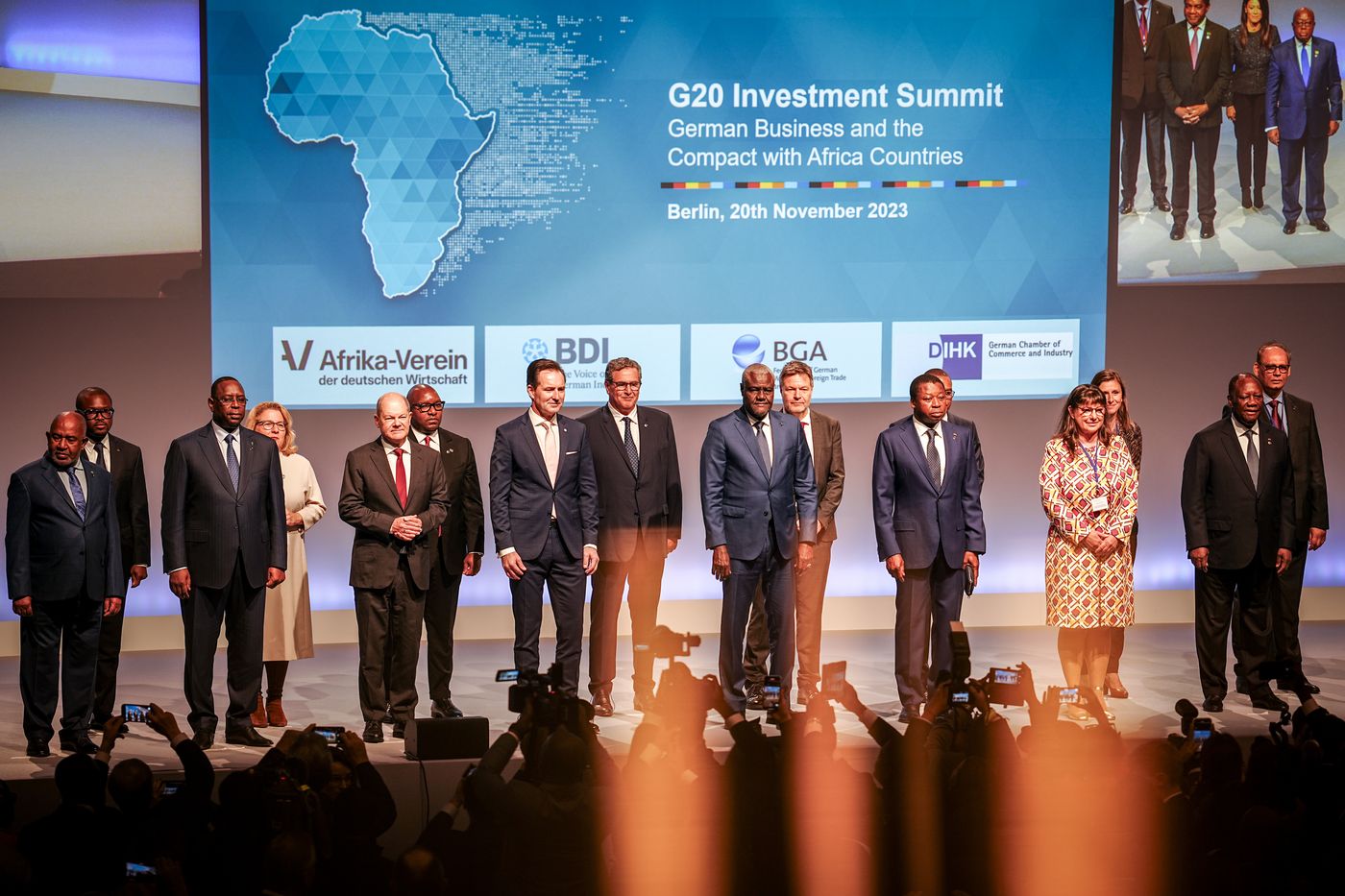
Heads of state and government from African countries, as well as members of the German cabinet, pose for a group photograph at the ‘G20 Investment Summit 2023: German Business and the Compact with Africa (CwA) Countries’, Berlin, 20 November 2023.
© picture alliance/dpa | Kay Nietfeld
With the Compacts with Africa (CwA), launched in March 2017, the German G20 presidency established a new approach to strengthen economic partnerships with African countries. Unlike traditional development cooperation, the focus is on creating investment-friendly framework conditions to mobilise urgently needed capital for economic development. Just under a decade after their introduction, we examine the extent to which the promises of the CwA initiative have been fulfilled – the few empirical findings available to date point to some successes, but also suggest a need for further research. In view of declining public funding for development cooperation, the focus is increasingly shifting towards the mobilisation of private capital. An empirical assessment of the effectiveness of the CwA initiative is therefore more relevant than ever.
Two Generations of ‘Compacts with Africa’
The CwA initiative was launched with the aim of creating a more attractive macro, financial and business environment for private investment in reform-oriented African countries. This took account of the fact that a large proportion of the capital required for Africa’s economic development must be met from non-state sources, and that the level of private investment on the continent had lagged significantly behind that of other regions.
Currently, 15 countries are participating in the CwA initiative. Most recently, Zambia and Angola were admitted in 2025. The initiative’s activities are coordinated and monitored by the African Advisory Group (AAG). This is a central steering body of the G20, which oversees the drafting and implementation of the Compacts and reports on the progress of the initiative. The AAG’s ongoing support is intended to ensure that progress on reforms is regularly evaluated and that potential challenges are identified at an early stage. This creates an institutional framework for coordination, monitoring and strategic development, the latter being particularly evident in the initiative’s two development phases.
In the first phase, from 2017 to 2024, the main focus was on macroeconomic conditions and a framework for business activities and financing. The aim was to achieve macroeconomic stability, remove bureaucratic hurdles and reduce risks for investors. The achievements of the first phase include support for more than 1,700 companies through individual advice, training and workshops, as well as the promotion of investment projects in the sectors of tourism, agribusiness and energy, which involves, amongst other things, simplified laws and regulations. According to the World Bank, the initiative reached 13.5 million people through the services it provided.
The second phase has been running since 2025 under the name ‘Compacts with Africa 2.0 ’. The focus is shifting: away from more general support for reform, towards concrete investments. The most significant change is the introduction of the so-called Multi-Donor Trust Fund. It creates a central financing instrument that pools funds from various donor countries to specifically mobilise private investment, facilitate advisory services and finance technical assistance. This is intended to help improve the implementation of reforms. In particular, private investment and job creation are now to be directly promoted, for example through concrete technical assistance in the execution of individual projects. The aim is to achieve a closer link between reforms and investment opportunities and to promote the development of sustainable value chains. Accordingly, CwA 2.0 focuses more strongly on measurable outcomes than CwA 1.0. However, even in CwA 2.0, it remains unclear how the support measures will translate in concrete terms into increased investment and, in the long term, into growth; in other words, there is no fully articulated ‘Theory of Change’.
A Promising Idea, But Inadequate Implementation
The core idea behind the CwA initiative – to improve the often inadequate institutional framework for private investment in Africa and to shift the focus towards macroeconomic stability – can, in principle, be regarded as a sensible extension of existing cooperation with African states. Long-term institutional improvements can send a signal to international investors and promote direct investment as a lever for growth, employment and technology transfer. It is less clear through which channels the initiative is intended to have a concrete impact. Until the establishment of the Multi-Donor Trust Fund, the Compacts were not backed by any significant financial resources or subject to conditionality. They cannot therefore function as a traditional incentive mechanism, but rather act as a means of self-commitment. They provide governments willing to undertake reforms with a document to which they can refer when dealing with their own bureaucracy and domestic political opponents. Furthermore, the Compact makes reform steps publicly visible. Whilst a reform agenda may already exist domestically, the Compacts can support this; however, the initiative does not itself generate reforms. Strictly speaking, the CwA initiative is aimed solely at reform-oriented governments, although the eligibility criteria have been interpreted very leniently in several cases.
Although there is broad consensus that Africa needs more private investment and that suitable framework conditions must be created for this, the CwA initiative has faced criticism from the outset, centring primarily on the issue of ownership of the reform agenda. The experience of the structural adjustment programmes of the 1980s and 1990s clearly shows that reforms imposed from outside as a precondition for financial support do not lead to the hoped-for positive results, because local governments do not identify with the reforms and therefore fail to implement them. Critics argue that the situation is similar with regard to the reforms under the CwA initiative.
Is this criticism justified? Unlike the structural adjustment programmes, countries can apply for membership of the CwA initiative by submitting proposals for reform programmes that reflect their own priorities. Nevertheless, the content of these programmes is significantly shaped by external actors (the African Development Bank, the World Bank, the G20, the IMF) during the implementation process. This creates the risk that reforms will result less from domestic political convictions than from external pressure. African partners implement the reforms independently, but may have only limited say in shaping them. This makes them vulnerable to setbacks or revisions should there be a change of government. The AAG is intended to ensure African participation as a means of mitigating this problem. In addition, the CwA initiative adopts a peer-learning approach, within which African countries are to learn from one another and assess each other’s progress in the reform process. In over 20 peer-learning sessions to date, covering topics such as diversification, blended finance, domestic resource mobilisation and public-private partnerships, country-specific experiences have been shared and discussed. Ethiopia, for example, presented its experiences of successful reforms to diversify the private sector at such a workshop in 2019 and shared the knowledge it had already acquired with other CwA members. In practice, however, it is evident that these peer-learning processes remain only of limited effectiveness if the content of the reforms continue to be defined predominantly by external actors. The Compacts with Africa 2.0 address this criticism by creating more scope for African priorities through the Multi-Donor Trust Fund. Overall, the CwA initiative significantly strengthens African agency compared with the structural adjustment programmes, even though power asymmetries between the G20, the international financial institutions and the African member states persist. The latter cannot be completely eliminated but could possibly be further reduced if greater reference were made to African frameworks such as the Agenda 2063.
Two further aspects could have a negative impact on the extent to which private investment targets are met. Small and medium-sized enterprises, in particular, cite not only shortcomings in the institutional framework but also the lack of a well-trained local workforce as reasons for their reluctance to invest in Africa. Against this background, the fact that the initiative does not explicitly provide for continuing professional development and training should be interpreted as a weakness of the CwA. Furthermore, the CwA is strongly focused on promoting foreign direct investment, whilst the strengthening of domestic investment – for example through improved financing conditions – is given less attention, even though domestic investment accounts for the lion’s share of total investment and creates far more jobs than foreign investment.
In addition to these structural issues, which concern the effectiveness of the CwA as an instrument for promoting private investment, questions of sustainability also arise. The CwA initiative relies heavily on growth through investment without systematically addressing the associated social and environmental risks. For instance, increased foreign direct investment may, under certain conditions, contribute to additional CO₂ emissions, and investment in the agribusiness sector may fuel land and resource conflicts. Linking investment targets to social and environmental policy objectives is likely to overburden the CwA initiative. However, evaluations of the major social and environmental risks could highlight the side effects of additional private investment and facilitate the implementation of countermeasures.
The Compacts with Africa Put to the Empirical Test
Have the CwA’s economic objectives been achieved, despite some conceptual weaknesses? The main problem in the empirical assessment of the CwA initiative is that, while quantitative analyses point to positive correlations between Compact membership and foreign direct investment, the causality of these effects is difficult to prove. For instance, a recent study by the International Monetary Fund (2025) shows that inflows of foreign direct investment into CwA member states are, on average, higher than in comparable African countries that do not participate in the initiative. However, no clear causal effect can be established because the member states were already recording higher inflows of foreign direct investment prior to the initiative’s introduction. As the institutional framework in the member states was, on average, already considered more favourable prior to the initiative’s launch in 2017, and additional key factors attracting direct investment were present, a causal interpretation of the findings proves difficult. Gbadegesin and Yameogo (2024) compare Compact participants with a control group of relatively similar African countries, but are also unable to identify a clear causal link. They find significant positive effects on foreign direct investment and export growth resulting from participation in the CwA initiative. However, these impulses do not yet appear to have translated into general economic progress: no corresponding improvements can be observed in gross fixed capital formation or per capita income.
Furthermore, there is a lack of robust systematic analyses examining whether short-term investment stimuli translate into long-term structural developments. Future research should therefore focus more closely on the institutional and political conditions under which the initiative can be effective, what potential sectoral differences exist, and to what extent rising investment inflows actually lead to increased employment and broad-based economic growth.
Right Direction, Room for Improvement in Implementation
Overall, the CwA initiative has achieved some successes. As demonstrated by the admission of 15 members to date and negotiations with further interested parties, it is being adopted by a significant number of African countries despite its modest financial scale. Compared with earlier initiatives, it has also taken significant steps towards greater African agency. Although empirical research to date has identified positive effects of the Compacts on foreign direct investment and exports, the methodology used does not allow for clear conclusions. Through targeted adjustments, such as aligning the reform framework more closely with the needs of domestic investors – for example, by promoting a tax system that favours the success of small and medium-sized enterprises – the likelihood of positive investment effects could be increased. Whether the hoped-for longer-term growth effects of the CwA can be realised is certainly open to doubt, not least because the concept remains vague regarding the mechanisms through which growth is to be generated.
With their focus on private investment, the CwAs cover an important part of development finance. Furthermore, at a time of dramatic cuts to development cooperation budgets, it is becoming increasingly important for African governments to mobilise additional domestic resources to finance, amongst other things, public investment in infrastructure and other public goods, which in turn can make private investment more profitable. In some African countries, the Compacts already include reforms aimed at strengthening the tax base; however, the interplay between public and private investment could be integrated even more systematically into the CwA in order to achieve the greatest possible overall impact.
Prof. Dr Rainer Thiele is Project Manager of Megatrends Africa, Director of the ‘Kiel Institute Africa Initiative’ at the Kiel Institute and Honorary Professor at Kiel University (CAU).
Tomke Necker is a research assistant at the ‘Kiel Institute Africa Initiative’ of the Kiel Institute.