Judging One’s Own Credit: Risks and Promises of an African Credit Rating Agency
Megatrends spotlight 66, 05.03.2026Faced with high borrowing costs, African leaders and the African Peer Review Mechanism (APRM) have selected Mauritius to host a continental credit rating agency to reduce dependence on the “Big Three” and counter perceived bias. But will investors trust it?
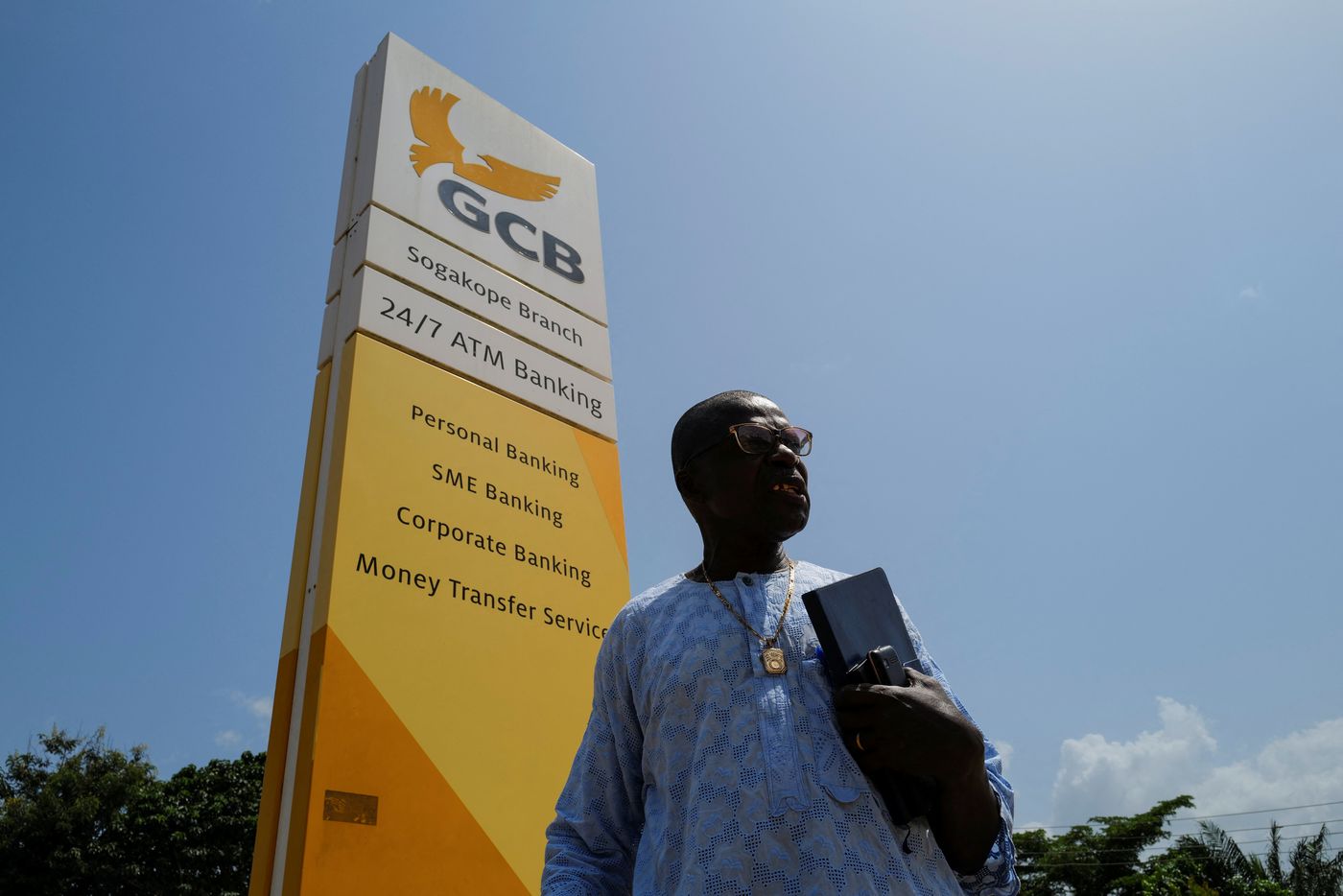
Three agencies rate 95 per cent of the world's debt — setting the cost of capital for governments and deciding who gets access to global markets. For African nations, the consequences are profound - as experienced first-hand by Emmanuel Amey-Wemegah, a retired policeman, at the Sogakope branch of Ghana's Commercial Bank in November 2024. A new African credit rating agency is now challenging that monopoly.
© picture alliance / REUTERS | Francis Kokoroko
For decades, three credit rating agencies – Moody’s, S&P Global, and Fitch – have defined the costs of capital for governments worldwide and mediated their access to capital markets. Their ratings influence more than 95 per cent of global debt and move billions in investment. When they downgrade a country, borrowing costs soar. This has real-life implications: governments may be forced to cut healthcare budgets or slash public infrastructure investments.
Now Africa is trying to change that. The African Union has mandated the African Peer Review Mechanism (APRM), its governance and accountability body, to establish a continental credit rating agency, with Mauritius selected as the host of this new African Credit Rating Agency (AfCRA). The agency is announced as a private-sector-led, independent body scheduled to begin operations in the second quarter of 2026. It aims to provide home-grown credit ratings, initially focusing on local-currency debt, in response to growing criticism of what many have termed the “Africa premium”.
AfCRA represents more than a technical fix to rating methodologies. It signals the emergence of regional alternatives to Western-dominated institutions, reflecting growing frustration among many developing nations with institutions they view as skewed toward developed-country interests.
The initiative has been hailed as a major step toward Africa’s financial independence. But sceptics question whether the agency can gain the credibility needed to influence global investors – and whether it can avoid the political pressures that might compromise its independence.
The case for an African agency
The push for an African-owned rating agency stems from longstanding frustration with the Big Three. Critics argue that their models amplify risk where data are thin, and underestimate resilience when political conditions improve.
Such criticism is not unique to Africa. Across successive financial crises the agencies have been implicated as contributors to instability. The US National Commission on the Financial Crisis labelled them “key enablers of the financial meltdown”. At the heart of these criticisms lie the issuer-pays model, the fact that agencies’ methodologies involve a good degree of subjectivity, and their oligopolistic dominance of the ratings market.
On the continent, a prevailing narrative holds that credit ratings are opaque, limited in coverage, and biased against Africa. A UNDP report argues that African economies are penalized not necessarily for weaker fundamentals, but because rating models fail to adjust for structural differences in data and institutions – creating what some call an “Africa premium”.
Yet empirical evidence complicates this narrative. While research shows that credit ratings contain home-country bias and subjective judgement, quantitative studies do not demonstrate a systematic Africa-specific penalty. Some studies find that emerging markets generally are rated less favourably than developed economies after controlling for fundamentals – suggesting systematic distortions, though no explicit regional penalty. Other scholars point to governance quality and institutional effectiveness as core drivers of low ratings rather than bias.
Africa’s credit landscape presents real challenges. The continent has a relatively high incidence of debt restructurings and small debt markets. As of 2025, only Botswana and Mauritius held investment-grade ratings, and only 32 African countries were rated at all. These factors magnify the impact of defaults on perceptions of creditworthiness. Without deep domestic bond markets or regional emergency financing, a downgrade can cut off market access entirely.
This said, calls to reduce dependence on the Big Three have intensified. Structural issues – including borrowing spreads that exceed what ratings suggest and limited on-the-ground analyst presence – continue to fuel scepticism among African stakeholders as to whether their markets are judged fairly.
The credibility challenge
AfCRA seeks to address these concerns by providing assessments rooted in local economic realities. Its success hinges on one critical factor: credibility. Any lack of transparency in its financial structure, or susceptibility to political interference, would be a serious liability.
Several African-based credit rating agencies already operate on the continent, including Augusto & Co., Bloomfield Investment Corporation, and Global Credit Ratings (GCR) – in which Moody’s recently acquired a 100% stake. These agencies have primarily focused on corporate and sub-sovereign ratings. Where methodologies have been made public, they show structural similarities to the Big Three’s approaches. Distinctive features exist as well. GCR, for instance, uses local expertise to establish national scale ratings, ranking issuers on their ability to meet financial obligations relative to other entities in the same country. It remains unclear how AfCRA will differentiate itself from existing African agencies.
AfCRA’s core challenge is investor recognition. Many institutional investors are bound to ratings from the Big Three, which are entrenched in global financial regulations as benchmarks for eligibility, capital requirements and risk management.
Unless AfCRA secures acceptance within these frameworks – a gradual process that requires a proven track record, methodological credibility, and regulatory recognition across multiple jurisdictions – its ratings are likely to have limited influence on international capital flows.
This challenge is not unique to Africa. Japan Credit Rating Agency and DBRS Morningstar took many years to achieve international recognition. AfCRA therefore faces an uphill battle in breaking into an industry long dominated by a small, entrenched oligopoly.
The agency’s postponed launch – with initial ratings now expected by June 2026 – may reflect institutional complexity and the high costs of establishing such an institution. But delays also risk undermining external credibility before operations even begin.
A transparent financial structure will be crucial to the agency’s credibility and long-term success. Most major rating agencies operate on an “issuer-pays” model – a structure that has drawn criticism from governments and regulators worldwide for its inherent conflicts of interest and susceptibility to undue influence on ratings outcomes. A robust regulatory environment that prevents business interests from compromising the accuracy and integrity of ratings would strengthen the agency’s reputational capital.
Then there is the risk of political interference. A continental body backed by member states must resist pressure to soften ratings for political convenience. Afreximbank’s 2023 public dispute with Fitch — in which the bank protested an “uninformed downgrade” and received support from the APRM, the same body now establishing AfCRA – underscores how politically sensitive ratings can become. APRM officials state that AfCRA will operate as an independent private entity, prepared to issue downgrades when this is warranted and focused on strengthening domestic capital markets through local-currency debt assessments. Its credibility, however, will ultimately depend on whether it can withstand political pressure and remain firmly committed to improving data quality and delivering objective, credible assessments.
Defining success
AfCRA is unlikely to lower African borrowing costs immediately. While the AU maintains that reducing country risk premiums will be “one of the prime indicators for success”, a more realistic near-term goal is providing high-quality data on African economies. If AfCRA reduces uncertainty and narrows perception gaps, that alone would constitute success.
A regional agency can build analytical capacity, strengthen data systems, and deepen debt-market infrastructure. Local rating ecosystems often boost transparency and financial literacy, enabling more domestic issuance in local currencies. Market reliance on ratings increases “when other data are limited and/or its veracity is questionable”. This is where AfCRA could make its greatest contribution – not by contradicting the Big Three, but by filling data gaps they overlook.
Another concern is fragmentation. If a sovereign receives a BB- from S&P and a BBB from AfCRA, which rating guides pricing? Conflicting assessments could confuse markets and deter investment. To prevent this, AfCRA needs transparent, published methodologies and, ideally, partnerships with established agencies for data calibration. The APRM has stated that AfCRA “is envisioned as a complementary institution to existing credit rating agencies”.
Financial markets consider more than ratings alone. Reducing rating bias would not eliminate investors’ own subjective decision-making. Government effectiveness and regulatory quality remain key determinants of rating – regardless of which agency conducts the assessment. These are structural factors that even an independent African agency cannot directly influence.
A path forward
Running a credible credit rating agency requires deep talent pools, secure funding and robust data infrastructure. Mauritius offers a well-regulated financial ecosystem, but attracting and retaining skilled analysts while guaranteeing independence from both governments and private sponsors will test AfCRA’s design.
For AfCRA to matter, it must do more than echo political rhetoric. Three practical steps could help:
Building credibility gradually. Begin with a limited portfolio and publish methodological comparisons with the Big Three. Once credibility builds, expand to sovereigns.
Safeguarding institutional independence. A board dominated by non-government professionals, transparent conflict-of-interest rules and third-party methodological audits can anchor trust.
Pursuing transparency and partnerships. Collaborate with institutions like the African Development Bank and IMF to standardize data, and make all assumptions and the financial structure public.
Success will not mean replacing Moody’s or Fitch overnight, but complementing them – offering a second lens on African risk. AfCRA alone cannot transform African borrowing costs. That requires parallel action by African governments themselves. As economist Vera Songwe notes, African governments must also do their homework: producing high-quality economic data, establishing robust debt management offices with transparent processes, and implementing institutional reforms that genuinely reduce investor risk. Benin has demonstrated how such measures can lower borrowing costs. Over time, with these institutional improvements, alongside an effective continent-wide regulatory structure, additional ratings could reduce volatility and give investors confidence that Africa’s story is being told in full – not filtered through incomplete models.
Dr Benedikt Erforth is project director of "Megatrends Afrika" at the German Institute of Development and Sustainability (IDOS).
