Mauritius’s Miracle Has a Leak: Protests Reveal Need for Reform
Megatrends spotlight 88, 04.11.2026Mauritius recently experienced a wave of protests sparked by severe water shortages, inflation, and high cost of living. Benedikt Erforth argues that this reveals deeper structural problems and outlines how the economy can return to growth by innovating and adapting.
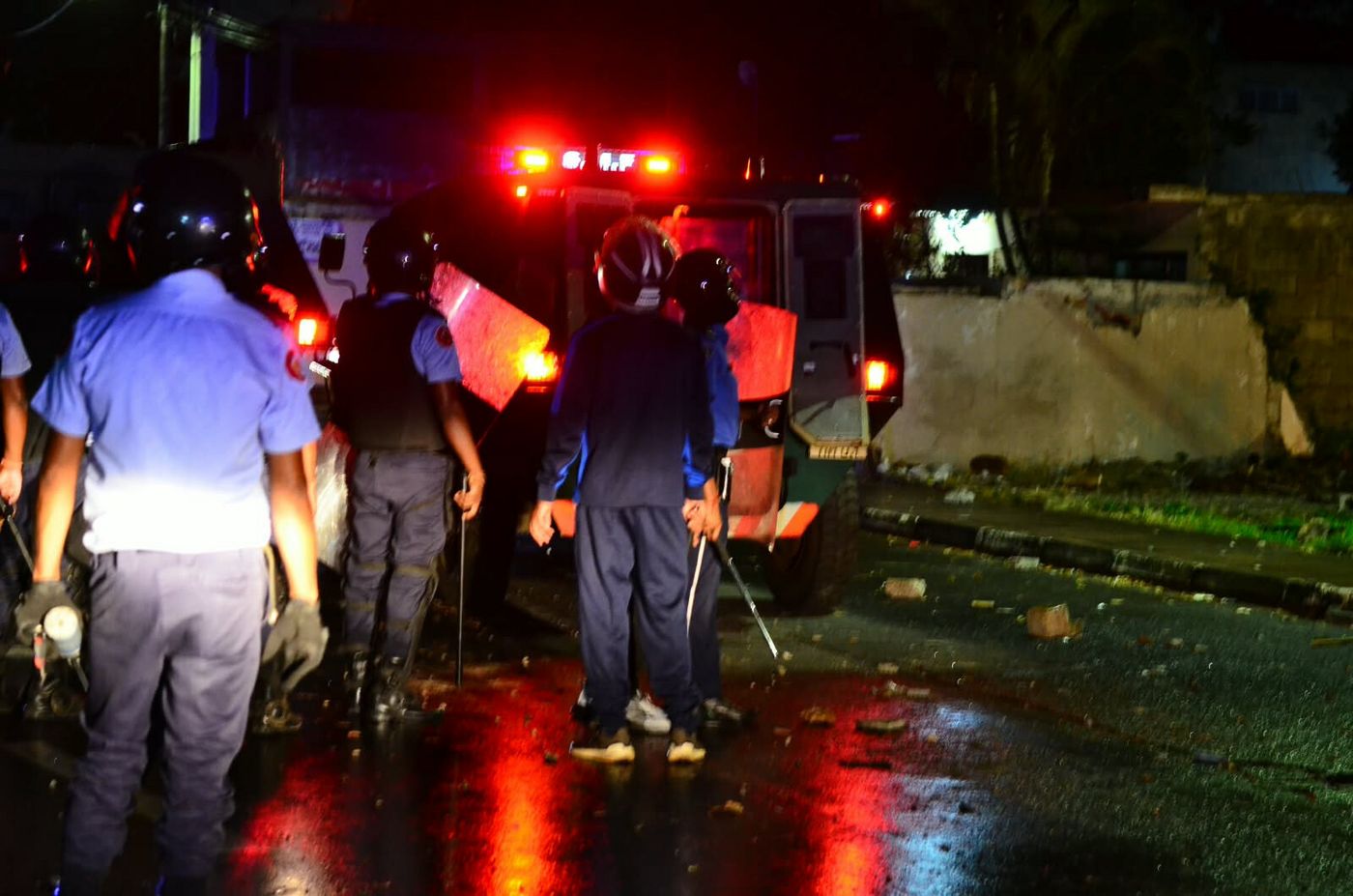
After Prime Minister Navinchandra Ramgoola announced a curfew, law enforcement officers guard the street in Saint-Croix, outskirts of Port Louis, Mauritius, October 12, 2026.
© picture alliance / Xinhua News Agency | Chen Shaohua
When the taps ran dry in early October 2026, few expected an island known for its stability and resilience to burn. Protests over severe water shortages and the cost of living in Mauritius began on 7 October and escalated on 9 October, when a police officer shot and wounded a 27-year-old woman. The officer was taken into custody and formally charged, but looting, arson and attacks on police stations continued. Prime Minister Navin Ramgoolam condemned the acts of vandalism and vowed to identify the instigators and hold them to account. A curfew was imposed, and at least 195 people were arrested. Since then, the situation has calmed.
It was the island’s worst unrest since the 1999 riots, which were triggered by the death in police custody of seggae artist Joseph Reginald Topize, known as Kaya. Many observers read those riots as an expression of the “Créole malaise”: the persistent inequality and poor housing, health and socio-economic conditions faced by many in the Creole community. The parallel with the current crisis lies in the police misconduct denounced and the fact that the sentiment of a “malaise général” is disproportionately felt by the Creole community.
The government has attributed the escalation to drug traffickers, and the Central Criminal Investigation Department has opened an inquiry into possible links between online disinformation campaigns and the spread of the protests. Neither explanation has been independently confirmed so far. Whatever role such actors played, they should not distract from the more structural root causes.
Persistent inequality and growing economic distress also drove people onto the streets. Short-term repairs to public infrastructure are necessary to address the immediate symptoms. The lasting task is to adapt Mauritius’s economic model to a changing global economy through specialization and innovation.
More Than the Lack of Water
The immediate backdrop was a water crisis. Mare aux Vacoas, the island’s largest reservoir, stood at 35.9 per cent of capacity on 6 October, against 88.6 per cent a year earlier. The Central Water Authority of Mauritius was forced to cut supply in neighbourhoods across the island, first trying to soften the cuts with mobile water tankers and a water tank grant scheme. The shortages came on top of rising prices and accelerating inflation. Following the closure of the Strait of Hormuz and the ensuing global supply shock, petrol prices rose by 10.7 per cent in the third quarter. This combination of the lack of basic services and rising cost of living sparked the first protests.
Mauritius is not an outlier when it comes to protest born of lived grievance. In 2025, youth-led protests swept Nepal, the Philippines, Indonesia, Kenya, Madagascar, Peru and Morocco. In Madagascar, just across the water, young people rallied against water and electricity shortages before the president was forced out. Europe is facing similar dynamics. In France, weeks of student protests over school conditions widened on 17 October into nationwide demonstrations against the cost of living, with looting, fires and severe clashes between rioters and police.
Although the Mauritian protests were not organized like comparable movements elsewhere, they too were fuelled by prices outrunning wages, rising inequality, economic uncertainty and failing public services. What makes the unrest particularly noteworthy is that it erupted in a society that has prized compromise over confrontation and has valued and marketed its stability since independence in 1968.
Water Supply and Affordable Energy as Short-Term Fixes
The protests have subsided for now, but they could return in some areas while shortages persist. To confront the public unease, the country must secure basic services now and continue to invest in its long-term economic strategy.
First, water. Climate change has reduced rainfall and increased the number of extreme weather events, but this is only part of the picture and does not explain the current water shortage on its own. A dense population, real estate development and tourism put the island’s water system under strain, and the infrastructure has not kept pace with the demand. For years, experts have attributed the shortages largely to domestic infrastructure failings. Much of the core network dates back 80 years or more, in some places even to the 19th century, and requires a general overhaul. The national utility loses 50–60 per cent of its water mainly to leaks, but also to theft and faulty metering.
There is an urgent need to replace about 1,500 km of old pipes. A pipe-replacement programme financed by an Indian line of credit of MUR 2.9 billion started in October 2026, and speed now matters. Fixing the pipes deserves at least equal priority with building new reservoirs. Meanwhile, the Central Water Authority is responding with a set of emergency measures: four new boreholes are to be drilled immediately, with 15 to 20 more planned in the medium term.
Second, energy. As elsewhere, the cost of living is being driven by energy prices. The island imported 90.9 per cent of its primary energy in 2024, so every oil shock becomes a bread-and-butter shock. The state’s capacity to absorb price fluctuations with tax money is limited, and doing so is not a sustainable solution in any case. Greater energy autonomy offers the most promising way forward. The target of 60 per cent renewable electricity by 2030 is as much an anti-inflation policy as a climate one and should be treated that way.
Medium- to Long-Term Economic Adaptation
Growth slowed from 4.9 per cent in 2024 to 3.2 per cent in 2025, and the International Monetary Fund (IMF) projects 2.8 per cent in 2026, with Middle East spillovers weighing most on tourism. Despite unemployment and rising inflation, Mauritius remains a stable economy, but a fairer income distribution needs fresh stimulus and more investment.
Debt reduction is necessary: the budget aims to cut public debt from 88 to 80 per cent of gross domestic product (GDP) by 2029 and to curb the basic pension for those earning MUR 50,000 or more per month. But a reform that lands on the middle class while the income gap between the richest and poorest tenth of households widened by 37 per cent between 2001 and 2015 invites resentment. Soaring property prices and foreign buyers add fuel to the fire. Any reform needs to balance debt reduction, fairness and the need for investment.
This balance is politically harder because the fiscal tightening follows a campaign that promised the opposite. After Pravind Jugnauth’s government was voted out in November 2024, Navin Ramgoolam’s Alliance du Changement had promised higher pensions, free transport and lower fuel prices. The coalition has since come under strain. In March 2026, Paul Bérenger resigned as deputy prime minister over the prime minister’s failure to appoint a finance minister.
Meanwhile, key growth sectors remain underused and state support still concentrates on weaker sectors. Tourism accounted for 22 per cent of GDP in 2024, and more than two-thirds of foreign investment goes to real estate, much of it tourism-linked. These sectors do little to lift productivity. The IMF cites high public debt, low productivity and an ageing society, and a 15 per cent US tariff and a shrinking labour force add to the pressure. Swift adaptation is nevertheless possible.
Reinvention under Pressure
Mauritius needs to do what it has done repeatedly: identify new productive sectors. Some steps in the right direction have already been undertaken, and a number of them are reflected in the 2026–2027 budget. They include the country’s digital strategy and its commitment to responsible artificial intelligence and connectivity. The willingness to defend its position as a financial hub between Africa, Asia and Europe was recently underlined by the inauguration of the African Credit Rating Agency in Port Louis on 7 October. Mauritius also invests in its image of being a reliable partner to all great powers by hosting the US-Africa Business Summit, now rescheduled for 6–9 December 2026.
For the future, short-term fixes and medium-term reform must go together. In the medium term, a new growth engine, whether the blue economy, financial or digital start-ups or an altogether different sector, has to be identified. Tourism and real estate alone are unlikely to lift growth or raise incomes for the broader population.
In 1961, James Meade, who later won the Sveriges Riksbank Prize in Economic Sciences in Memory of Alfred Nobel, predicted a bleak future for an island too dependent on sugar and too vulnerable to terms-of-trade shocks. His deeper worry was Malthusian: too many people on too narrow an economic base. At independence, sugar accounted for 30 per cent of GDP and 90 per cent of exports. The island moved into textiles, then tourism and finance, and proved Meade wrong. Reinvention under pressure, combining diversification with niche specialization, is the Mauritian method, and against all initial odds it has largely worked. Now the problem is the mirror image: an ageing population, a shrinking workforce and a society growing old. Youth-led protests are usually associated with fast-growing, youthful populations, yet here a demand for a fairer share of the miracle is rising in an ageing one. The test is whether Mauritius can adapt its state quickly enough to meet it, against the backdrop of an unpredictable and volatile global economy.
Dr Benedikt Erforth is a Project Director of Megatrends Afrika and a Senior Researcher at the German Institute of Development and Sustainability (IDOS).
