Post-GenZ Protest: Lessons from Kenya, Madagascar and Mozambique
Megatrends spotlight 91, 23.11.2026Across Africa, GenZ-led protests placed massive pressure on governments. Yet, systemic change is stalling. Lena Gutheil, Sheila Ronoh and Magdalena Freischlad argue that without sustained pressure from activists, voters and international partners, the early promise of these movements will be lost.
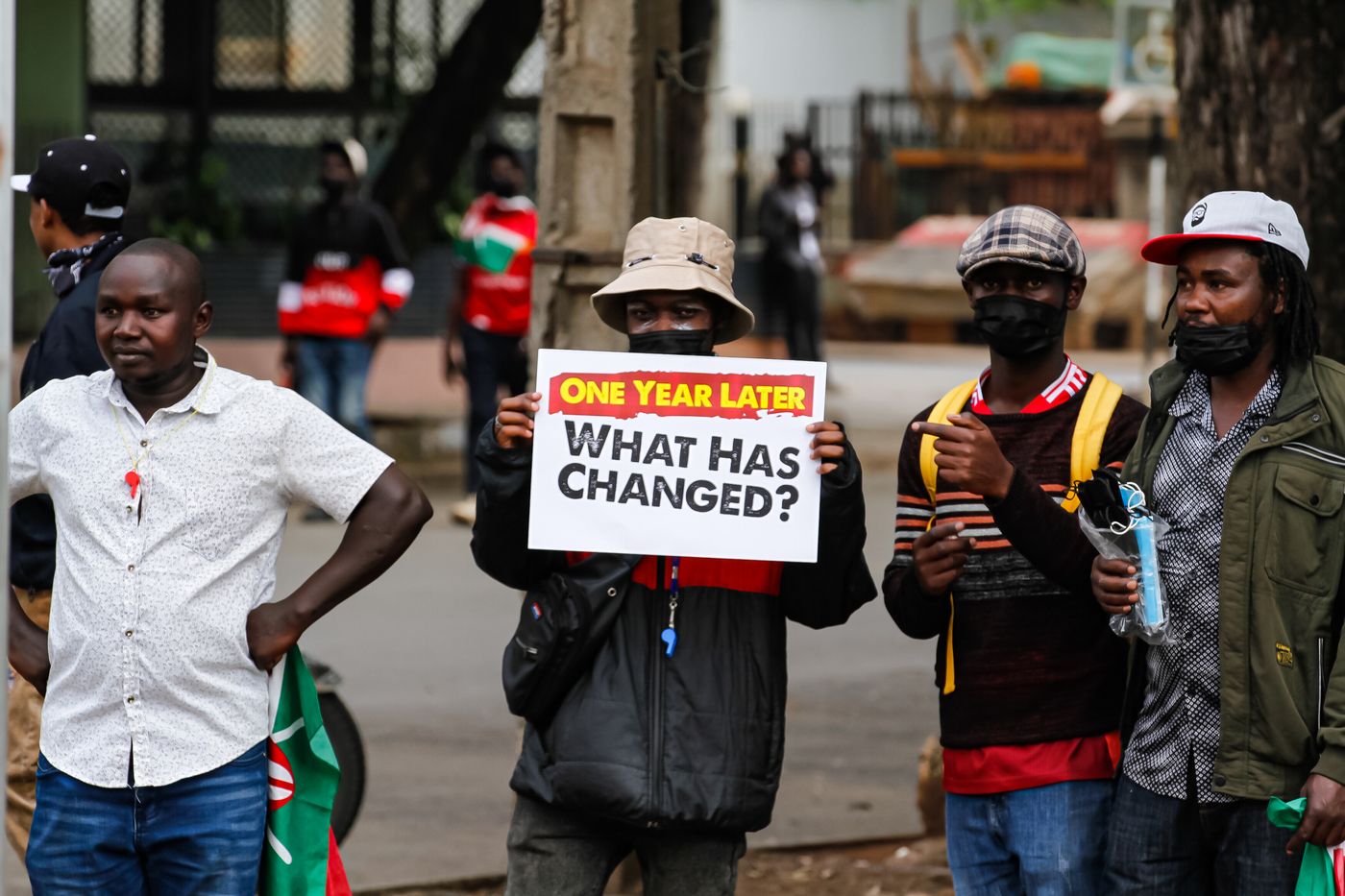
A protester displays a placard during a protest which marks one year since the anti-tax demonstrations and that is held to commemorate those who lost their lives on 25th June 2024, in Nairobi, Kenya, on June 25, 2025.
© picture alliance / ZUMAPRESS.com | Boniface Muthoni
In recent years, protests, predominantly led by the so-called GenZ, a demographic cohort of people born between the mid-1990s and the early 2010s, have taken place in a number of African countries and beyond. Despite the immediate triggers being different, the underlying grievances were often remarkably similar: pro-democratic youth activists demand government accountability, fair elections, the end of corruption and improved service delivery. Social media played a key role in organizing the protests, a factor that made it difficult for governments to suppress them. Furthermore, the sheer number of protesters put enormous pressure on political elites to react.
In all three countries, concessions were made. In Madagascar, protests against chronic water and electricity shortages even led to the ousting of President Andry Rajoelina in October 2025. A military government took over. This marked the first instance in which a mobilization under the GenZ label contributed to the overthrow of a sitting government in Sub-Saharan Africa. In Kenya, protests in 2024 against a Finance Bill meant to raise about 2.7 billion dollars, partly through higher taxes on essentials such as bread and cooking oil, led the government to withdraw the bill and dismiss its cabinet. In Mozambique, the controversial elections in October 2024 sparked months of mass protests in response to allegations of widespread electoral fraud. Opposition candidate Venâncio Mondlane, who was particularly popular among the younger population and claimed victory in the election, rejected the allegedly rigged election results and called for nationwide demonstrations via social media. GenZ played a central role in the ensuing nationwide protests. In response to the protests, the government established an Inclusive National Dialogue.
Despite these concessions, in all three countries systemic change has not materialized. What lessons can we draw from the protests? And how can international actors support pro-democracy activism?
Lesson 1: GenZ Movements Created Momentum, but Sustaining It Is Difficult
In all three countries, GenZ activists created enormous momentum by mobilizing street protests through digital means. Protesters rallied around shared objectives that reflected, not least, the discontent felt throughout society. Yet, the momentum gradually subsided as the political situation evolved.
In Madagascar, frictions emerged after the regime change. One major GenZ group announced it would proceed autonomously after civil society organizations (CSOs) had become more dominant in strategic decisions and imposed more formalized working practices. The movement also fragmented along cleavages mirroring broader divides in Malagasy society, and some actors were reportedly co-opted by the regime, which set up its own youth groups.
In Kenya, in a similar manner, the GenZ movement has struggled to maintain cohesive engagement as a united bloc across the country. Its leaderless structure has been cited by some activists as a factor contributing to this challenge, particularly as some of its most prominent faces can no longer be relied upon to serve as channels of communication either due to co-option or government repression.
In Mozambique, street protests subsided with the creation of the Inclusive National Dialogue, which aimed at institutionalizing the protesters’ demands. The official goal of the two-year dialogue is to provide a platform through which the entire population can submit proposals for structural reform. A technical committee, COTE (Comissão Técnica de Concertação), is then tasked with analysing these proposals and developing concrete suggestions for structural reforms. Initially, the Inclusive National Dialogue created hope among the general population, particularly among GenZ, that their grievances were finally being addressed by the government. However, this hope is increasingly giving way to a sense of distrust towards the dialogue process, which is accused of being manipulated by the government to prevent far-reaching reforms.
Lesson 2: New Avenues for Participation Do Not Immediately Translate into Systemic Change
In the aftermath of the protests, the face of activism changed. While, overall, the transition from protest to institutional politics has created new opportunities for participation in all three countries, it remains uncertain whether these will translate into political influence and structural change.
In Madagascar, youth activists characterized the ill-managed process of the recently initiated national dialogue, which the World Council of Churches oversees, as a façade. The process is supposed to ascertain citizens’ priorities and feed them into the formulation of a new constitution. Organized civil society had previously started their own dialogue process, in order to formulate recommendations for the transition. Here, youth representatives were invited but were not in the driving seat.
Concurrent with the declining street protests, individual activists have turned towards electoral politics in Kenya. Some work at the grassroots on voter registration and civic education; others plan to run for office in the 2027 elections or found a new party. Forums such as the National Youth Baraza aim to build understanding of the political system, but scaling them up nationwide would require resources that young people lack.
In Mozambique, a key issue with the Inclusive National Dialogue is the selection of stakeholders participating in the technical commission (COTE), which is composed of representatives from nine political parties and three CSOs. Mondlane and his party, ANAMOLA, remain excluded. Moreover, even established and politically independent CSOs have not been admitted to COTE. The GenZ-led organization DECIDE was only admitted after strong political pressure, showing that their role does not automatically translate into systemic change. While youth organizations have had the opportunity to submit reform proposals to COTE, it is unclear to what extent these proposals are taken into account.
Lesson 3: Regimes Respond with a Mix of Concession, Co-option and Repression
The three countries have contrasting political contexts shaping their responses to the protests. Madagascar has a long history of political instability, involving a military coup by the same unit in 2009. The transition in 2025 – unlike in 2009 – is, however, not led by a civilian leadership, but by the military. The military leadership continues to entrench its power through a tactical combination of co-option, public consultations and increasing political repression.
In Kenya, the civil society pressure and the wide media coverage of the GenZ movement led the government to withdraw the Finance Bill. The president also reshuffled the cabinet and held a dialogue with GenZ on the social media platform X. This was the first time in Kenya’s history in which political dialogue of this nature, and mediated by the president, had taken place. Since then, several prominent GenZ activists have aligned themselves with the government, even amidst allegations that they have been co-opted. At the same time, Human Rights Watch reported how the government reacted to continued protests with shootings, arbitrary arrests and abductions. The regime also waged an online campaign of disinformation and counternarratives against protesters, and deployed state-sponsored “goons” to identify and intimidate online activists.
In Mozambique, too, the announced reform process was accompanied by ongoing repression – including the political assassination of opposition politicians, activists and demonstrators – as well as a government that, by its own admission, is driven by an unconditional will to power, resulting in a country governed in an increasingly autocratic manner. The fact that Mondlane, as of 17 November 2026, will stand trial in connection with his involvement in the protests shows that, while official political concessions are being made, politicians and activists are simultaneously being targeted through repression.
Thus, concessions by the government in all three countries went hand in hand with co-option of movement figures, attempts to influence and manipulate actors as well as repression.
How Can International Actors Support Democratic Reforms?
International actors need to have a deep understanding of the local context and dynamics and act with foresight. Visible foreign support could feed “foreign-funded” narratives used against movements. That is why, first and foremost, donors and other international actors should respect the “do-no-democratic-harm” principle.
In Mozambique, international actors – especially those already funding the Inclusive National Dialogue – must critically monitor the dialogue, and examine whose voices are included in the reform proposals and whose voices remain marginalized – rather than equating formal participation or organizational visibility with democratic legitimacy or representativeness. Funding should be transparent and subject to clear accountability requirements, while independent civil-society monitoring should be supported to scrutinize both the dialogue and the implementation of its outcomes.
For Madagascar – here the dialogue process has only just begun – these insights are particularly valuable. As in Mozambique, there is a risk that marginalized groups will not be adequately represented or that the dialogue will degenerate into a tokenistic exercise. To avoid this, Madagascar should rely on participatory selection mechanisms, transparent funding and independent monitoring structures from the very beginning.
In the Kenyan case, donors can support young people’s pathways into politics, for instance by supporting CSOs that equip young people with the skills needed to engage effectively in political processes and democratic governance. Donors can also support initiatives that promote civic education and, more specifically, voter education. As preparations for the elections in 2027 start, international partners can also support the implementation of a sound election process and invest in election monitoring.
Last, but not least, it is key that donors continue providing funding for civil society actors – not just in dialogue and electoral processes. This should include training and mentoring programmes, and where necessary, psychosocial support, legal aid and protection mechanisms for young civic actors. Such investment can help strengthen the resilience of such youth-led movements. At the same time, public pressure from international actors and partner governments is needed to counter state repression and demand accountability from governments.
Dr Lena Gutheil is a researcher at Megatrends Afrika and an Associate with the German Institute of Sustainability and Development (IDOS).
Sheila Ronoh is completing her PhD at the University of Coventry, Great Britain. She is a 2026 Megatrends Afrika Research Fellow at the SWP in Berlin. Her research interests focus on youth activism for climate and sustainability in Kenya and Uganda.
Magdalena Freischlad is a research associate at the University of Konstanz. She conducts research on reconciliation processes and local knowledge production in post-conflict societies, with a focus on Mozambique.
