China’s Scientific Cooperation with Africa
Megatrends spotlight 83, 03.09.2026Chinese scientific cooperation with Africa is shaped by both state-led initiatives and actor-driven partnerships, spanning digital transformation, agriculture, public health, satellite remote sensing, joint research, and capacity building, argue Hangwei Li and Han Cheng.
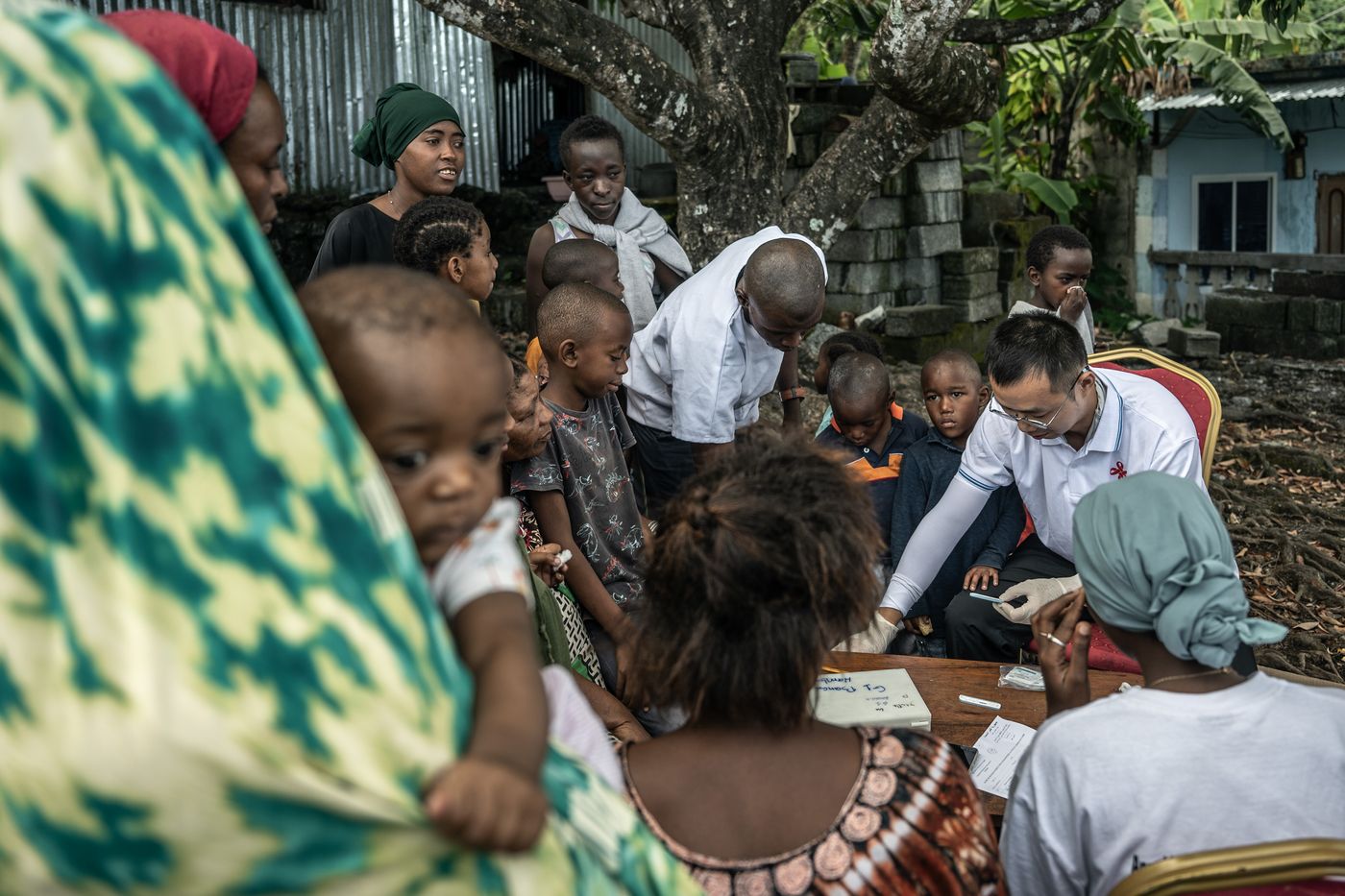
A medical team for anti-malaria service performs blood tests in a village north of Moroni, Comoros, August 27, 2024.
© picture alliance / Xinhua News Agency | Wang Guansen
Decoupling has dominated recent debates on China’s scientific and technological cooperation with global partners, especially with advanced economies such as the United States and European countries. While American and European science cooperation with China has raised controversies due to growing concerns about intellectual property, research security, and geopolitical competition, China’s scientific and technological cooperation with Africa has attracted relatively little international attention. China–Africa relations continue to be discussed primarily through the lenses of politics, debt, trade, infrastructure, and development cooperation. However, scientific and technological cooperation has long been part of China–Africa relations and has expanded considerably since the launch of the Belt and Road Initiative, while becoming increasingly important to China’s global scientific and technological rise.
As we show below, China’s scientific cooperation with Africa cannot be understood simply through the lens of a unified and centrally directed strategy. Many of these developments are also shaped by bottom-up initiatives involving Chinese companies, universities and researchers, or, more specifically, by the interaction between Chinese state-led frameworks and these bottom-up initiatives. For German and European policymakers, understanding these dynamics is increasingly important for assessing the broader science and technology landscape in which African partners operate and for developing a more tailored and strategic approach.
Unlike China’s cooperation with advanced economies, which has often centred on access to frontier research, leading laboratories, and highly developed scientific systems, China’s cooperation with Africa has generally not focused on the joint development of frontier technologies. Yet, Africa is becoming increasingly important to China as a region where Chinese science and technologies can be deployed, scaled and adapted to local conditions, and expanded across different countries and sectors. This takes place through concrete forms of cooperation, such as partnerships between Chinese technology firms and African universities, training programmes, joint laboratories, digital platforms, and the use of satellite and remote-sensing technologies in agriculture, transport, urban planning, and disaster prevention.
State-led Technology Scaling
China’s scientific and technological cooperation with Africa is not something new; it has long been an important part of China–Africa relations. Earlier cooperation, especially in the fields of public health and agricultural development, can be traced back to the Cold War era, particularly in the context of Third World solidarity, anti-colonialism and national liberation movements. Since 1963, when China sent its first medical team to Algeria, public health assistance has been one of the enduring forms of China–Africa cooperation. Early scientific and technological cooperation also included sharing agricultural technology and dispatching technical experts.
China’s scientific and technological cooperation with Africa is driven by both top-down initiatives and bottom-up practices. At the state level, scientific and technological cooperation has been an integral focus of the Forum on China–Africa Cooperation (FOCAC) since its inception in 2000. In particular, in 2009, the Ministry of Science and Technology of China launched the China–Africa Science and Technology Partnership Program (CASTEP), which marked a further institutionalization of China-Africa scientific and technological cooperation. The 2025–2027 FOCAC Beijing Action Plan shows that cooperation has moved on further from traditional aid-oriented cooperation toward a broader agenda of digital transformation, agricultural modernization, green development, public health, satellite remote sensing, joint laboratories, and science-and-technology capacity building.
Furthermore, for strategic fields such as space, China has established various centres in Africa to promote its BeiDou System – China’s satellite navigation system – and has expanded cooperation with African countries on satellites, remote sensing, data applications, and technical training. BeiDou has been applied in areas such as agriculture, urban planning, infrastructure construction, transport, surveying, and disaster prevention and mitigation in Africa. While BeiDou is often viewed as an effort to challenge the dominance of the US-owned Global Positioning System (GPS), African governments and institutions may engage with it primarily for its immediate developmental, environmental and technical utility, rather than as a geopolitical choice between China and the United States. The expansion of BeiDou from technical cooperation and training into applications across agriculture, transport, surveying, and disaster management illustrates how a Chinese technological system can move beyond isolated demonstration projects and become embedded in multiple sectors.
A parallel development has taken place in the production of knowledge about Africa within China. After decades of recognizing its limited understanding of the countries it engages with, the Chinese government has promoted the development of area studies, including African Studies, over the past decade. In 2022, area and country studies was formally elevated as tier-one level national discipline. This development reflects a wider effort to produce more systematic knowledge about the societies, political systems and economies in which Chinese state agencies, companies, universities, and other organizations increasingly operate. As Beijing promotes the development of area studies, it also encourages more scientific and technological cooperation with Africa, signalling a deeper reconfiguration of the relationship between research cooperation and state strategy.
Bottom-up Scientific Cooperation
While we have witnessed the state’s push to strengthen China’s scientific and technological cooperation with Africa, many activities on the ground have been initiated from the bottom up. For instance, as part of their corporate social responsibility (CSR) efforts, many Chinese firms, especially digital and technology firms, have collaborated with African universities and research institutions to offer scholarships and skills development, develop laboratories, and conduct experiments together with African scientists. Chinese university professors, driven by academic entrepreneurship and competition for influence, have also developed various initiatives to strengthen partnerships with African universities and research organizations. China Agricultural University (CAU), for instance, has established seven “China-Africa Science and Technology Backyard” sites in Zambia, Tanzania, and Malawi, where Chinese and African scientists jointly explore scientific ways to improve food productivity, such as maize production.
These bottom-up activities demonstrate that China’s scientific and technological engagement with Africa cannot be reduced to the execution of a unified, centrally directed strategy. Chinese companies, universities, and individual researchers pursue their own interests, such as market access, research funding, publications, professional networks, and institutional influence. African governments, universities, firms, and researchers also have their own priorities and interests. They are not passive recipients of Chinese initiatives, but actors seeking financing, equipment, training, international partnerships, and technological alternatives that are otherwise difficult to obtain. At the same time, Chinese state-led and bottom-up initiatives often reinforce one another. Policy frameworks create funding opportunities and political incentives, while companies and researchers translate broad commitments into concrete partnerships, and technical applications and projects.
These transformations directly affect advanced economies including that of Germany. Germany’s scientific success has long relied on international openness, the mobility of talent, and participation in global research networks. However, the dynamics underpinning this system are rapidly shifting due to various challenges, many of which also arise domestically. For German policymakers, developing a better understanding of how China’s scientific and technological cooperation with Africa is reshaping global research networks and the broader global science system is becoming increasingly important. Crucially, this also requires an understanding of what these developments mean for Germany’s and Europe’s own scientific interests and partnerships. A more nuanced understanding of these changes and dynamics will be important for developing effective policies regarding science, innovation, technological diffusion, and international collaborations.
Dr Hangwei Li is an associate at Megatrends Afrika and a senior researcher at the German Institute of Development and Sustainability (IDOS).
Dr Han Cheng is a principal investigator of the Volkswagen Foundation-funded project “China’s Science Silk Road and the New Geopolitics of Knowledge Production”, a senior research scholar at the Max Planck Institute for the History of Science in Berlin, and an adjunct professor at Université Laval’s Graduate School of International Studies in Quebec, Canada.