Sino-Indian Rivalry: Competition, Collaboration and African Agency
Megatrends spotlight 67, 09.03.2026China-India relations have recently stabilized, although rivalry persists, fuelling competition in Africa over economic sectors, resources and narratives. Hangwei Li and Raj Verma examine how African governments can leverage dynamics of competition and convergence to strengthen their agency.
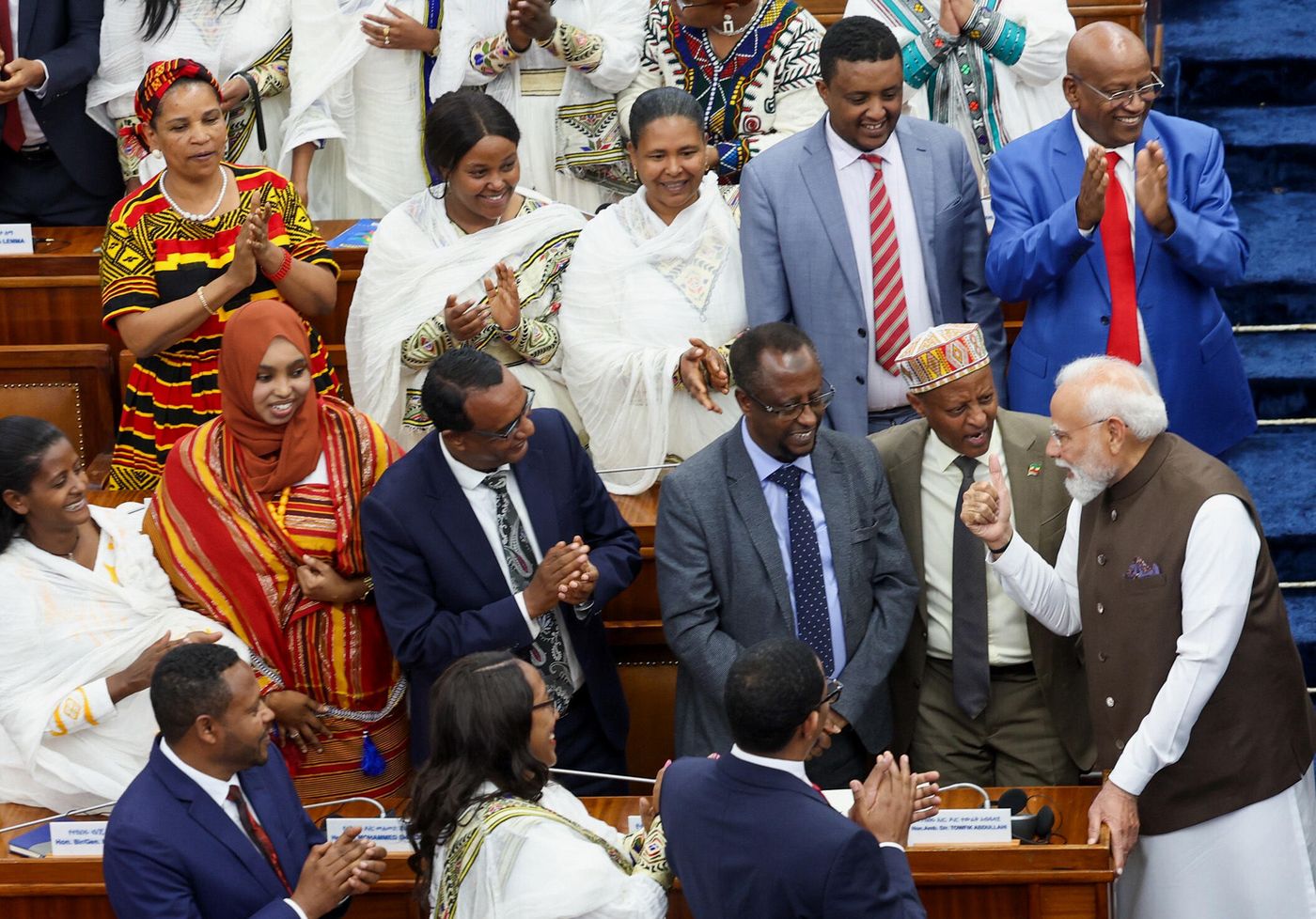
On his first bilateral visit to Ethiopia, the Indian Prime Minister, Narendra Modi, addressed a joint session of the Ethiopian parliament in Addis Ababa on 17 December 2025, recalling the contribution of Indian teachers and Indian businesses to the growth and prosperity of Ethiopia. He emphasized that both countries, as nations of the Global South, must stand together to give greater voice to developing countries.
© picture alliance / Anadolu | Press Information Bureau (PIB)
On India’s Republic Day on 26 January 2026, Chinese President Xi Jinping publicly described China and India as “good neighbours, friends and partners”, using the metaphor of the “dragon and elephant dancing together”; he stressed the importance of cooperation and stable relations. After years of India-China ties being governed largely through border crisis management, some signs of normalization have started to appear. Last year, Indian Prime Minister Narendra Modi travelled to China for the Shanghai Cooperation Organisation (SCO) summit in Tianjin – his first state visit to China since 2018 – marking “steady progress” in China-India relations.
India-China relations had been in limbo since the Galwan Valley clash in June 2020, which exacerbated mistrust and tensions between the two countries. The rapprochement between the two countries has accelerated amid a changing global geopolitical landscape. Despite the Xi-Modi optics, both countries continue to perceive each other as rivals in their pursuit of great power status and “striving to be above the other in the hierarchy of great powers". As noted in our recent paper in International Politics, since their formation, the two countries have competed with each other for influence in the Global South, with both considering themselves to be leaders of the realm. The African continent, as we argue below, is a key arena in which such rapprochement and rivalry intersect, and where the implications of both are particularly visible.
Intensifying Sino-Indian Economic Competition in Africa
In Africa, the competition between China and India has been visible for decades. In more recent years, such competition has especially intensified in sectors tied to strategic resources. The continent possesses massive amounts of critical minerals, including sizable stores of cobalt, manganese, lithium and rare earths. Chinese mining companies, both state-owned and private firms, have expanded across the continent and have already locked up key supply chains in the Democratic Republic of Congo and Zambia. India has been trying to close the gap by building a more diversified portfolio of deals across multiple countries. China and India are not only seeking to secure access to mines, but also to the supply chains that move and refine these minerals.
As both countries compete to lock in resources for their manufacturing and clean energy sectors, African governments sometimes find themselves wooed by differing financing and delivery models. China’s approach emphasizes infrastructure and resource-tied finance via policy banks and rapid turnkey delivery. India, by contrast, relies more on a partnership-oriented mix: Exim Bank lines of credit, grants and capacity-building and private-sector participation. In recent years, India has increasingly targeted solar and digital services, which are also heavily targeted by China. The competition is real as the two countries serve as benchmarks against one another, yet their models often operate in parallel, expanding host-country bargaining space.
Moreover, diaspora-linked businesses and private firms from China and India now compete across manufacturing, retail and construction sectors. It is well known that one of India’s key advantages in Africa is its longstanding diaspora presence. More than three million people of Indian origin live across the continent. Over time, these communities have played a crucial role in strengthening bilateral ties. They also serve as commercial intermediaries embedded in local economies. Since China launched its “Going Out” policy in the early 2000s, Chinese migration to Africa has increased, with over one million Chinese migrants estimated to be living on the continent, and with it private investment has grown. The rise of Chinese private capital and diaspora-linked businesses has begun to challenge the long-established presence of Indian businesses.
Narrative and Soft Power Competition
There is also competition between India and China in their narratives, soft power and models of cooperation with Africa as both countries seek normative legitimacy as preferred partners for the continent. For instance, in February 2025, at the Japan-India-Africa Business Forum, Indian External Affairs Minister Subrahmanyam Jaishankar said, “Unlike extractive models of engagement, India believes in capacity-building, skill development and technology transfer, ensuring that African countries not only benefit from investments but also develop self-sustaining growth ecosystems.” Indian media outlets interpreted the phrase “extractive models” as referring to China’s activities in African countries, while Chinese media, including the Global Times, published commentaries to counter the narrative.
India’s soft power approach has traditionally emphasized scholarship programs, technical training and people-to-people exchanges, along with leveraging its non-state actors and cultural symbols, such as yoga and Bollywood. However, the long absence of the India-Africa Forum Summit (IAFS) has raised questions about the institutional consistency of India’s Africa outreach. China has also expanded its soft power outreach through education (including through scholarship schemes and deepening institutional cooperation), capacity-building programmes (including party-to-party cooperation), culture (including the export of films and soap operas), expanding media engagement, and scientific collaboration (including strengthening its space partnerships) in Africa. All these efforts will shape how African elites, as well as the general public, perceive these two countries, their development models and the credibility of the competing partnership claims.
Competition, Convergence and African Agency
India and China not only compete for influence in Africa, but also cooperate with each other in Africa, especially when host-country-led, issue-specific cooperation is plausible where capabilities are complementary. For instance, through the BRICS and the G20 platforms, both countries have shown congruent positions on debt restructuring and global financial governance reforms. If this congruence is deepened, Africa might see the formation of joint funding instruments or cooperation between the two countries in certain areas. Beyond finance, India and China have aligned on elements of global governance reform relevant to Africa. For example, both supported the African Union’s elevation to permanent membership in the G20. When it comes to maritime security around the Horn of Africa, both have participated in counter-piracy efforts and operational coordination mechanisms, illustrating how limited cooperation can coexist with strategic rivalry.
As for how African governments respond to the shifting geopolitical environment, governments from Abuja to Nairobi are actively pursuing non-alignment 2.0 and/or multi-alignment strategies to achieve strategic autonomy and maximize their geopolitical, geo-strategic and geoeconomics interests. Their tactics reflect pragmatism as they juggle great power competition, seek to diversify their partnerships to prevent (over)dependence, expand their areas of cooperation and control their own development agendas.
Where rapprochement leaves room for cooperation between China and India, it may squeeze Africa’s bargaining power. For instance, when China and India converge (e.g. in multilateral bargaining over debt-treatment principles or on global financial governance reforms), African governments may find fewer opportunities to arbitrage external disagreements.
Conversely, where rivalry persists, multi-alignment can increase leverage. For instance even in small island state like Mauritius, the reasons Mauritius did not join the Belt and Road Initiative (BRI) include pushback and diplomatic pressure from New Delhi. Despite Mauritius not joining the BRI, it successfully negotiated the Mauritius-China Free Trade Agreement (FTA) with China, signed in October 2019 and effective from January 2021, which was also China’s first FTA with an African country. Such development not only strengthened Mauritius’s bargaining power in negotiating a trade agreement with China, but also increased pressure on India to offer Mauritius more favourable trade terms.
Moreover, while much scholarly and policy debate has called for enhancing African agency amid global geopolitical competition, the more grounded question is what this agency should deliver. For African countries navigating the China-India rivalry, the objective should not be choosing sides, but being clear about the outcomes: negotiating transparent, fiscally safer and sustainable deals that generate tangible spillovers (e.g. technology transfer, stronger local suppliers, greater value addition), rather than more headline projects. Because both China and India bring distinct legal frameworks, standards and political implications, this rivalry will inevitably increase the complexity of negotiation and oversight for African governments. Managing each offer and engagement requires bureaucratic depth and institutional capacity that many states are still developing. In other words, the sustainability of engagement with the two Asian giants, and the ability to successfully navigate their rivalry, depends largely on African governments’ capacity to align these partnerships with their broader foreign and economic policy objectives.
Dr Hangwei Li is an Associate at Megatrends Afrika and a Senior Researcher at the German Institute of Development and Sustainability (IDOS). Dr Raj Verma is a political scientist and a non-resident scholar at the Sigur Center for Asian Studies, Elliott School of International Affairs, George Washington University.
