African Scholars in China: Education Mobility as Soft Power?
Megatrends spotlight 73, 17.06.2026China pledged more scholarships to African students than Western governments combined. Using LinkedIn data, we show that they study engineering and business in China, and, back in Africa, work in education and sectors tied to China-backed projects. This may underpin China’s geopolitical soft power.
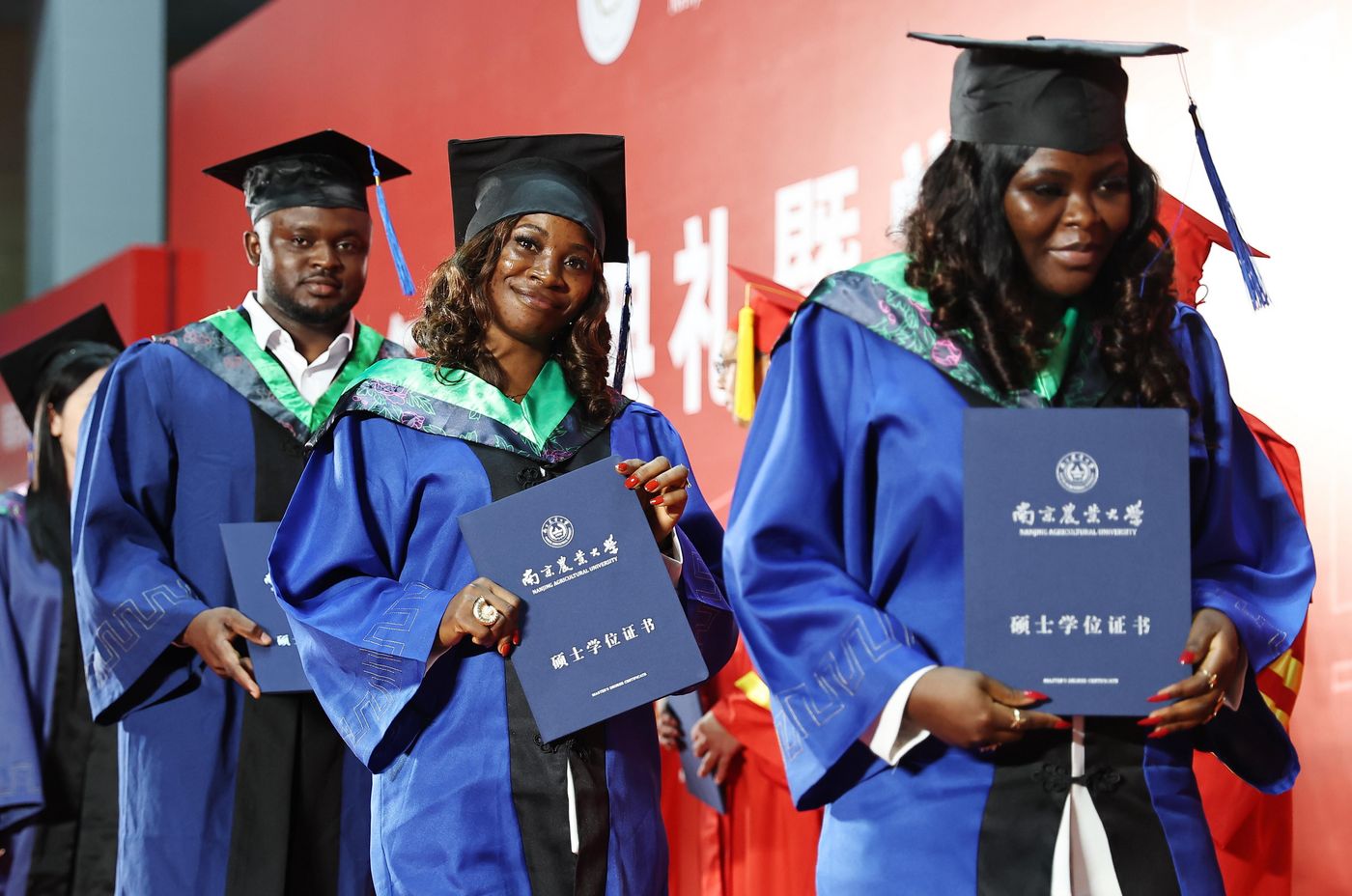
International students receive their diplomas during the 2026 graduation ceremony at Nanjing Agricultural University in Nanjing, east China's Jiangsu, 16 June, 2026.
© picture alliance / Sipa USA | Imaginechina
The Rise of China as an Education Hub
For decades, the global architecture of higher‑education mobility was dominated by the United States and a small group of European countries. More recently, China has become a major hub in international higher education, creating a second major centre in East Asia alongside the traditional transatlantic one. This development has been driven in large part by the rapid expansion of Chinese government scholarship programs targeting African countries. A recent Nature article reports that, in 2018, China pledged more than 50,000 scholarships for African students over the subsequent three years and now provides more university scholarships to Africans than all Western governments combined. Consistent with this expansion, official figures from China’s Ministry of Education show that the number of students arriving from Africa to study in China has risen sharply over the past two decades, from almost zero in the late 1990s to around 80,000 by the late 2010s. The scholarship surge goes along with the better-documented expansion of Chinese aide, lending, trade and foreign direct investment across the continent.
Beyond Aggregate Statistics
To study this phenomenon, this spotlight draws on LinkedIn data provided by Revelio. The data provides self-reported education (study fields, institutions, countries, start- and end-date) and employment histories (positions, companies, countries, start- and end-date). We classify somebody as a China-educated African if they have completed at least one step of their education (secondary school, a bachelor’s, master’s or a doctoral degree) in an African country and one in China. We exclude individuals with Chinese names, leaving us with 33,021 individuals.
Using LinkedIn data comes with important caveats. LinkedIn users are a selected subgroup rather than a representative sample of all Africans who have studied in China. As LinkedIn is not widely used in China, Africans who remain there after their studies are likely underrepresented, and our data may better capture returnees to Africa, while moves to Europe and the United States—where LinkedIn is more established—are probably recorded more completely. We therefore cannot compare aggregate numbers. The platform is also more attractive to some groups than others: it is more common in internationally oriented careers and sectors such as technology, consulting and international organisations, and less so in small local firms, the informal sector, or parts of the public sector.
Africans Studying Engineering and Business in China
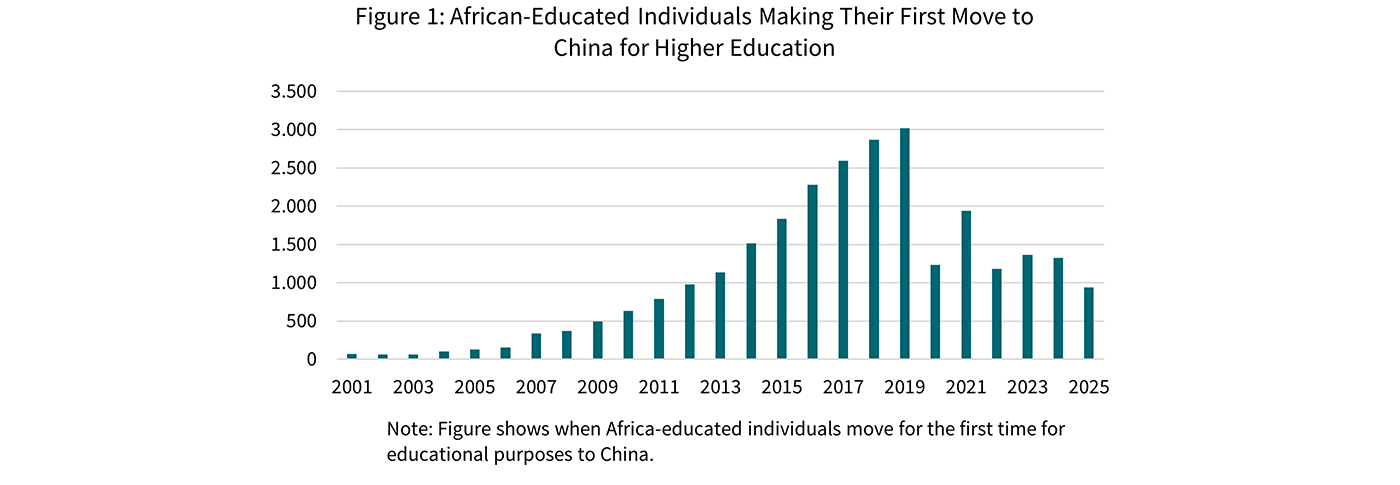
Our LinkedIn sample, in line with official numbers seen above, shows an increase in African mobility to China for higher education over the past two decades. Figure 1 shows that, until the mid‑2000s, only a few dozen Africa‑educated individuals per year moved to China for the first time. Numbers then rose steadily and accelerated from the late 2000s onwards. The trend broke sharply in 2020 and has not returned to pre‑pandemic levels since, a shift that we discuss further below.
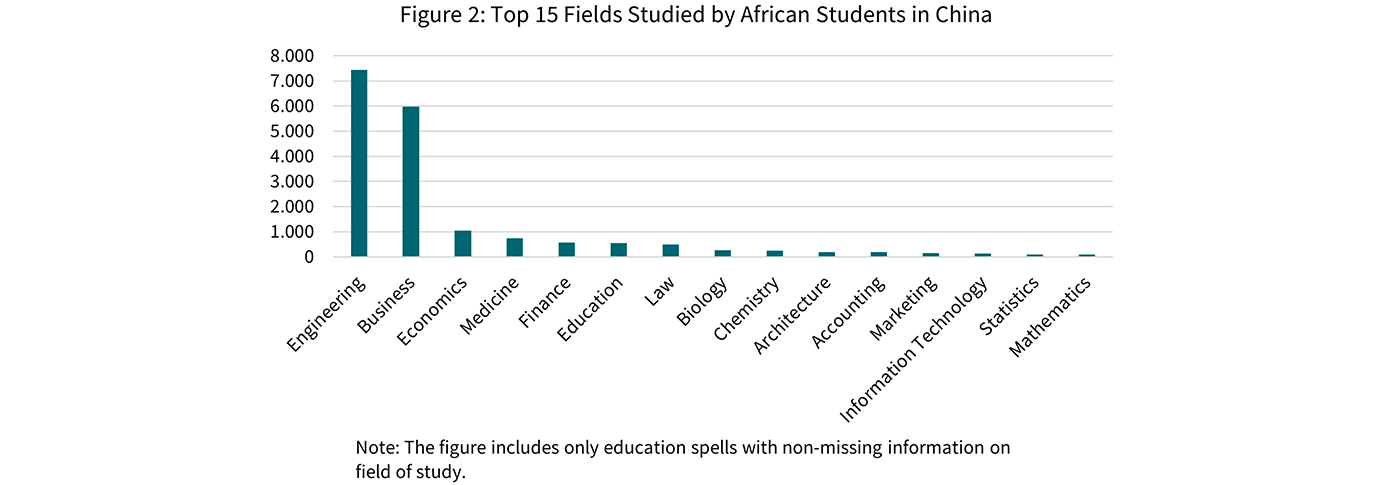
In China, African students are heavily concentrated in engineering and business‑related programmes (Figure 2). These fields account for by far the largest share of enrolments, followed at a distance by economics, medicine, and finance. By contrast, the humanities are barely represented. This pattern aligns with the broader structure of China’s engagement in Africa, where infrastructure, energy and construction projects are central, and suggests that scholarship offers and program capacity are particularly strong in fields linked to these activities.
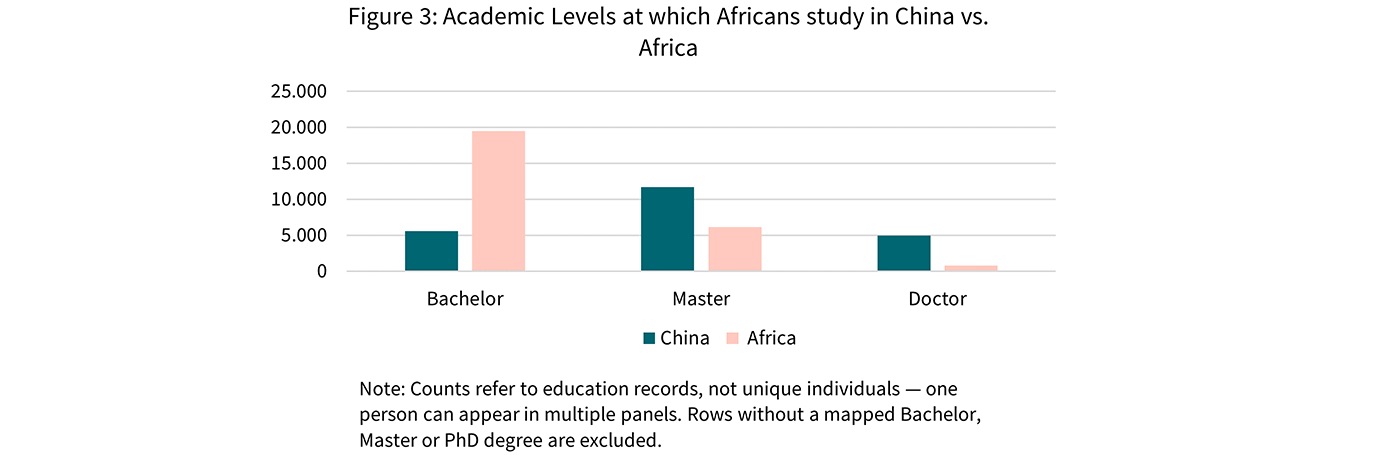
Most individuals complete their first degree in Africa and then move to China for a master’s program (Figure 3). Nearly 5,000 individuals are listed as pursuing doctoral studies in China. The average stay for education in China is 2.8 years. Our LinkedIn sample is heavily concentrated in elite, internationally oriented universities such as the University of Hong Kong, Peking University and Tsinghua University.
An open question is who exactly takes up the opportunity to study in China in the first place. Chinese scholarships could be functioning as a partial substitute for Western education for children of African political and business elites, creating future decision-makers whose international networks are anchored in Beijing rather than in Western capitals. For students from non‑elite households, Chinese scholarships may open access to tertiary education that would otherwise be out of reach. Among those, scholarships will be primarily accessible to the best students; hence they are likely to structurally tilt toward upwardly mobile groups. The LinkedIn data cannot tell these two channels apart, but both are consistent with the aim of expanding soft-power: through elite political networks in one version, through career attachment to Chinese-linked sectors in the other.
Post‑Study Employment Patterns
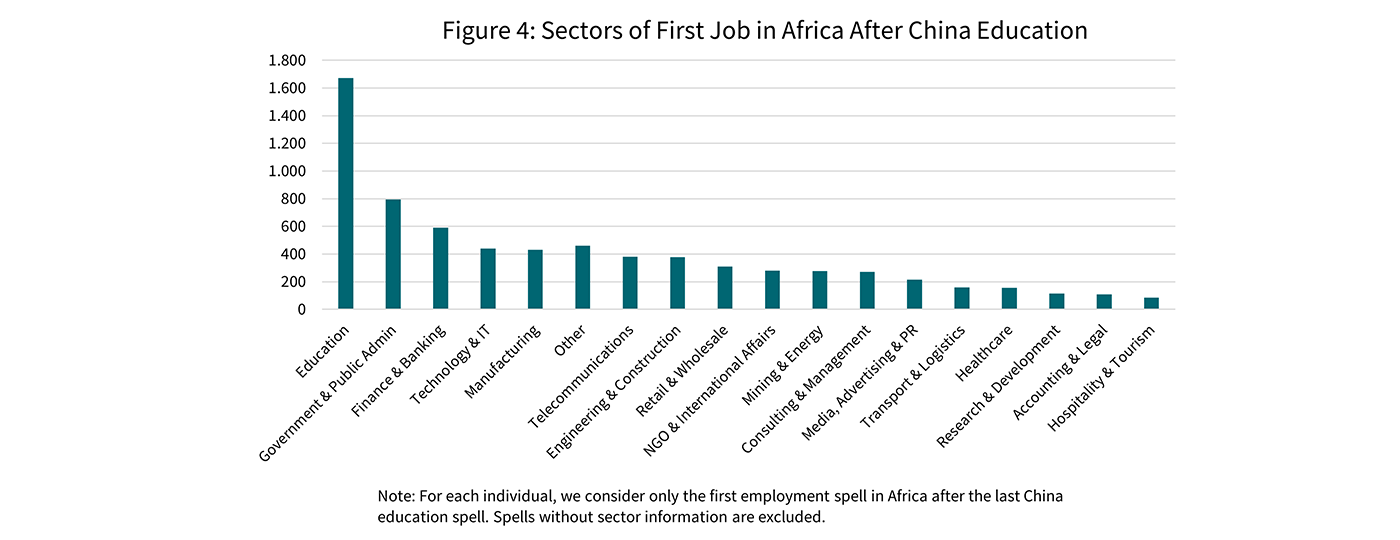
Within the limitations discussed above, our data indicate that most individuals return to Africa after completing their education in China, while smaller groups stay in China or move onward to Europe or the United States. Among returnees to Africa, the majority start working at universities. They are also represented in government and public administration, finance and banking, and strategic industries such as technology and IT, telecommunications, engineering and construction, and mining and energy (Figure 4). Many of these sectors are central to planning and running large infrastructure and resource‑extraction projects in Africa, suggesting that some China‑educated returnees may occupy positions that help broker or facilitate Chinese‑backed projects. At the same time, returnees employed in educational institutions may further disseminate the knowledge, skills, and professional norms acquired during their studies in China.
Most China‑educated Africans in our sample who work in Africa report African employers. However, a small number also start working at large Chinese companies such as Huawei and state‑owned construction and telecom firms (e.g. CSCEC, CCECC, CRBC, CRCC, ZTE, OPPO), as well as regional and international organisations like the African Union and the United Nations.
Soft Power but What Kind?
China's rise as a higher-education destination for African students is no longer a minor footnote in global education mobility. The LinkedIn data described here offer a first individual‑level view of these trajectories, showing that many Africans study in fields such as engineering and business at Chinese universities and then return to work in sectors where Chinese economic activity on the continent is concentrated. This circulation of graduates creates the basic conditions for higher‑education mobility to function as a channel of Chinese soft power. Measuring such soft‑power effects is, however, beyond what our data can do.
But what kind of soft power, exactly? We can think of two distinct ways in which such soft power might operate. One is a functional channel: China-educated returnees who work in telecoms, construction, mining, energy, and public administration are well-placed to translate between Chinese investors and African institutions through knowledge of language, standards, and habits. The other is attitudinal and harder to pin down. Spilimbergo (2009) for example shows that foreign-educated individuals take home political values from their host country. It may be the case that China-educated Africans carry Chinese policy ideas, narratives, and models of governance back to the continent. However, experiences of African students in China are mixed, and reports of discrimination and racism may counteract attitudinal gains that scholarship schemes are meant to yield.
Two open questions stand out. First, the 2020 plateau. Is the post-pandemic stagnation a temporary disruption, a structural change in Chinese scholarship policy at a time of falling net financial flows in other areas of Chinese engagement on the continent, or a reflection of African demand falling away from China for unrelated reasons? Second, the selection question, namely whether scholarship recipients are drawn predominantly from elite households, deepening political ties between Chinese institutions and the next generation of African decision-makers or whether they are reaching further down the income distribution, broadening the cohort?
Scholarships have long been understood as instruments of foreign policy, and Europe has always treated them as such. France runs its scholarship programmes through the foreign ministry and the UK calls the Chevening programme a soft-power instrument outright. The rise of China as an educational hub is a turning point though, shifting the centre of gravity in international education away from the U.S. and Europe. But seeing this as a contest for the loyalty of African graduates misreads it. In a multipolar world, it will be in emerging elites’ interest to develop plural ties. What is genuinely rivalrous is much narrower than the soft power influence. It arguably is the technical standards, equipment, and administrative templates that African engineers, regulators, and procurement officials build the continent's physical and political infrastructure on. Those choices create path dependencies and a generation trained in one system tends to build in that system. Whether Europe remains part of that build-out depends less on goodwill than on whether its standards and training are still on the table when Africa's choices harden into systems.
Carolin Formella is a doctoral student at LMU Munich and Junior Research Fellow at the Max Planck Institute for Innovation and Competition. She is also part of the “Next Geo” cohort and a Junior Excellence Fellow at the Kiel Institute.
Prof Dr Tobias Heidland is professor of Economics at Christian-Albrechts University, Director of the ‘International Development’ Research Centre at the Kiel Institute and Co-Project Director of Megatrends Afrika.