Reinforcing Regime Security and Authoritarian Rule: Regionalism in the Sahel
Megatrends spotlight 90, 18.11.2026
September 2026 marked the third anniversary of the founding of the Alliance of Sahel States (AES). The regional organisation has little to show for itself. However, for the military juntas in Burkina Faso, Mali and Niger the AES remains a key pillar in maintaining their power, writes Denis Tull.
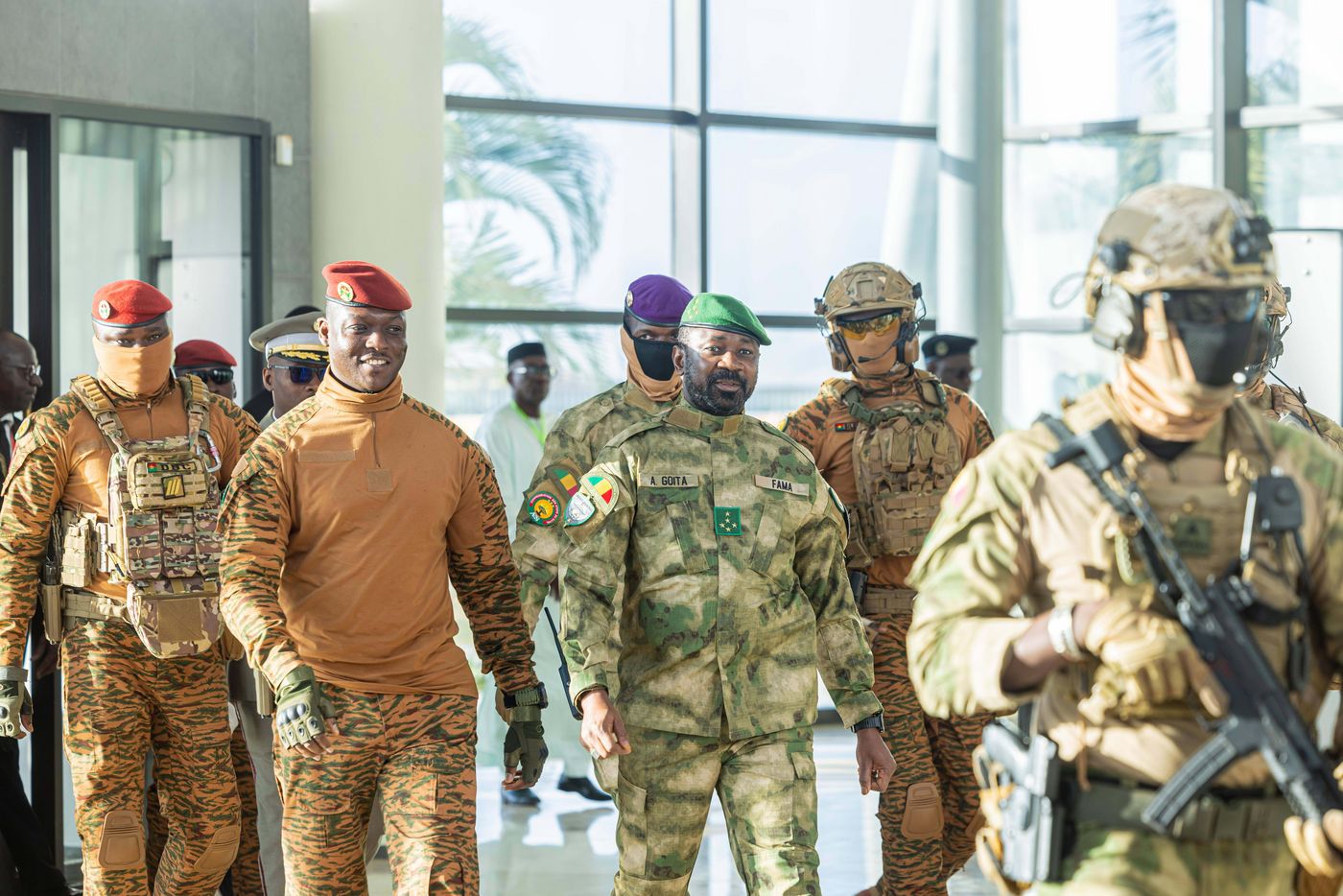
Burkina Faso's President Captain Ibrahim Traoré, second left, walks alongside Mali's President General Assimi Goïta during the Alliance of Sahel States (AES) second summit on security and development in Bamako, Mali, Tuesday, Dec. 23, 2025.
© picture alliance / ASSOCIATED PRESS | Uncredited
Transnational cooperation between autocrats is an increasingly significant phenomenon in international politics – and thus a relevant field of political science research, as a recently published study also emphasises. The focus is often on the relationships between major and regional autocracies, or between such powers and other states. Examples of such transnational cooperation include the partnerships that the military regimes of Burkina Faso, Mali and Niger have intensified since 2022 with Russia, as well as with China and Turkey.
Less attention, however, is paid to the question of why and how the military governments in the Sahel cooperate with one another. By founding the Alliance of Sahel States (AES) and withdrawing from the Economic Community of West African States (ECOWAS), the three juntas have not only disrupted the established order and weakened the regional integration model that has existed since 1975. They have also build their own form of regionalism, creating a framework that serves, above all, to maintain their hold on power. Mutual solidarity and cooperation within the new AES framework have generated domestic political support for the regimes and expanded their scope for action in foreign policy. Cooperation between like-minded autocrats has thus become an opportunity structure in the sense of a ‘regime-strengthening regionalism’. This was facilitated by the fact that the three regimes shared a similar, indeed almost identical, starting point: on the one hand, armed jihadist uprisings and existential state crises, which, domestically and socially, facilitated the military’s seizure of power; on the other hand, a hostile regional and international environment that condemned this move.
The Hallmark: A Confrontational Foreign Policy
As was to be expected, international partners – ECOWAS, the African Union and the EU – duly responded to the coups in Mali (2020), Burkina Faso (2022) and Niger (2023) with sanctions designed to force a return to ‘constitutional’ order. The military juntas, however, did not yield to international and regional pressure. On the contrary, the threats from external actors became a catalyst for trilateral cooperation. In September 2023, Burkina Faso, Mali and Niger founded the Alliance of Sahel States. In January 2024, they announced their collective withdrawal from ECOWAS – not least to convey that they did no longer consider themselves bound by the Economic Community’s rules, which stipulate constitutional principles and zero tolerance towards coups. The three juntas have consistently pursued their hard-nosed course. To this day, they remain unwilling to make even the slightest concession to ECOWAS, such as returning – if only formally – to a constitutional order (‘transition’) in order to open the door to a normalisation of relations with the organisation.
Discourses on Sovereignty for Internal and External Legitimisation
The juntas’ radical policies found broad support within society, all the more so as the three regimes presented themselves as a like-minded, united community. This applied not only to the argument that a state of emergency and the management of the crisis in their respective countries required extraordinary measures – going beyond democratic and constitutional politics. It also applied to the rejection of external interference, namely sanctions – described as ‘illegal, illegitimate, inhumane and irresponsible’ – as an attack on national sovereignty and self-determination. The synchronisation of these discourses conveyed political unity both domestically and internationally and was, not least, a strategy to counter the attempts by ECOWAS and Western governments to isolate them.
Thus, the confrontational foreign policy course – steeped in sovereignty – towards the ‘external enemy’ (ECOWAS, France) became an identity-forming hallmark not only of the military regimes themselves, but also of their cooperation with one another. Domestically, this generated considerable support. The formalisation of cooperation in the context of withdrawal from ECOWAS and the establishment of their own regional organisation followed this logic. The move was an attempt to give their shared political agenda a visible and stabilising structure. In Mali, for example, 91 per cent of respondents in a survey stated that they supported the country’s withdrawal from ECOWAS. 87 per cent believed that the AES took their country’s interests into account appropriately.
The Dilemmas Facing ECOWAS
The resulting dilemma for ECOWAS – and indeed for the EU – was obvious: how could a policy of isolating military regimes, initiated in the name of democracy, be credible and effective when the juntas based their domestic legitimacy precisely on their rejection of external interference and democracy? All evidence suggests that ECOWAS’s policy was not only ineffective but actually counterproductive, as it further fuelled the juntas’ rhetoric about the real or imagined ‘external enemy’. To make matters worse, the three regimes had in the meantime been canvassing for further ECOWAS states, such as Guinea and Togo, to join the AES. This raised the spectre of further fragmentation of ECOWAS.
But that was not all. ECOWAS also faced a security dilemma. The security situation in the Sahel has continued to deteriorate. Insurgents, predominantly jihadist rebel groups, are continuing to gain ground and are increasingly expanding into neighbouring states, in particular Togo, Benin and Nigeria, but also Senegal and Côte d’Ivoire. The frozen diplomatic relations between AES states and ECOWAS members meant that security cooperation also largely collapsed.
In view of this situation, the ECOWAS states have gradually abandoned their policy of isolation towards the three AES members since 2025. They are now focusing on ‘pragmatism’ and a normalisation of relations, without normative criteria, let alone conditions (regarding democracy and the rule of law), playing any role. The political unity of the AES coalition was a crucial prerequisite for this.
Performative Regionalism
The formalisation of regional cooperation under the AES banner should not obscure the fact that the latter continues to be more of a political alliance than a regional organisation. From an institutional perspective, it remains largely a façade. Its three member states symbolically present the AES as a fully-fledged organisation by holding summits and ministerial meetings, maintaining a rotating presidency and passing numerous resolutions – such as those on the introduction of an AES passport and a common anthem. They have also established a common duty on certain imported goods, intended to help finance AES measures. Nevertheless, the organisation’s structure and operational capacity remain extremely limited, even if the constant stream of announcements and communiqués is intended to convey the opposite. For instance, the prospect of establishing an investment and development bank and an AES court has so far been raised without any concrete results. Even in the field of security and defence policy, there is little of substance to be seen. In particular, the announced establishment of a 5,000-strong joint AES force seems still a long way off.
Given the unrelenting crises that all three governments are struggling with, the discrepancy between statements and implementation comes as little surprise. It is probably even factored in. The significance of the AES for the military regimes in Burkina Faso, Mali and Niger lies less in its concrete activities as a regional organisation than in its performative function. Through symbolic action, the juntas use the AES to create a political reality. It is an institutionalised solidarity club that enables them to represent their shared domestic and foreign policy interests.
Learning and Emulation between the AES states
Beyond formal mechanisms, a more diffuse form of cooperation between the AES military governments involves mutual learning and emulation processes. This refers to the tendency to adopt or emulate certain strategies, practices and decisions of the other juntas. In this way, political consensus and like-mindedness is signalled both internally and externally. Shared membership of an organisation – the AES – can facilitate exchange and mutual learning in this regard.
Although the existence of such learning processes is a proposition that cannot be empirically verified, it is nevertheless evident that the three regimes often operate in parallel across various fields. Foremost among these is the nationalist-populist discourse on sovereignty and its concept of the external enemy. This discourse was first established in Mali and then adopted as a tried-and-tested model in Burkina Faso and Niger. The juntas also take similar or even identical approaches to political and economic measures, for example with regard to the state’s resource-nationalist policies in the mining sector. Further parallels can be seen in the creation and instrumentalisation of certain institutions, such as pseudo-parliaments and national dialogue forums, which serve to legitimise the regimes and in some cases even bear identical names. The three states’ joint withdrawal from the International Criminal Court (ICC) is also worth mentioning here.
Conclusion
Similar domestic and foreign policy circumstances have prompted the juntas in the Sahel to abandon the existing multilateralism within the ECOWAS framework and replace it with a new form of regionalism that is tailored to their interests. The confrontational foreign policy stance towards the ECOWAS region and the international community has, in turn, strengthened domestic support for the three regimes. Conversely, this domestic support has increased the juntas’ bargaining power in external negotiations – particularly with ECOWAS. It is not the juntas that have approached the organisation; rather, it is the ECOWAS states that are courting the AES members.
However, this track record does not mean that the alliance serves as a political lifeline for the three regimes, nor does it mean that authoritarian regionalism is sustainable in the long term. The fall of a single junta could upset the entire balance of power. Furthermore, given the scarcity of resources, there is nothing to suggest that the regimes are in a position to provide each other with concrete material support – for example, in the field of security policy. On certain issues, they will continue to struggle to agree on a common position, such as in their dealings with Algeria. Ultimately, the AES is a solidarity club of like-minded but extremely precarious military regimes whose political survival hangs by a thread – as demonstrated this year by the rebel attacks in Mali in April and the attempted coup in Niger in August. For ECOWAS, however, the alliance poses a serious problem. Not so much because the organisation has lost its three poorest member states, but because this has called into question West Africa’s model of regional integration.
Dr Denis Tull is a Project Director of Megatrends Afrika and a Senior Associate in the research division Africa and Middle East at the German Institute for International and Security Affairs (SWP).