The Untapped Potential of Labour and Education Migration from Africa to Germany
Megatrends spotlight 75, 02.07.2026
While public debate on migration in Europe focuses mainly on irregular migration, regular routes for labour and education migration from Africa have been expanding. Whether these become fair and mutually beneficial pathways will depend on how they are designed and supported.

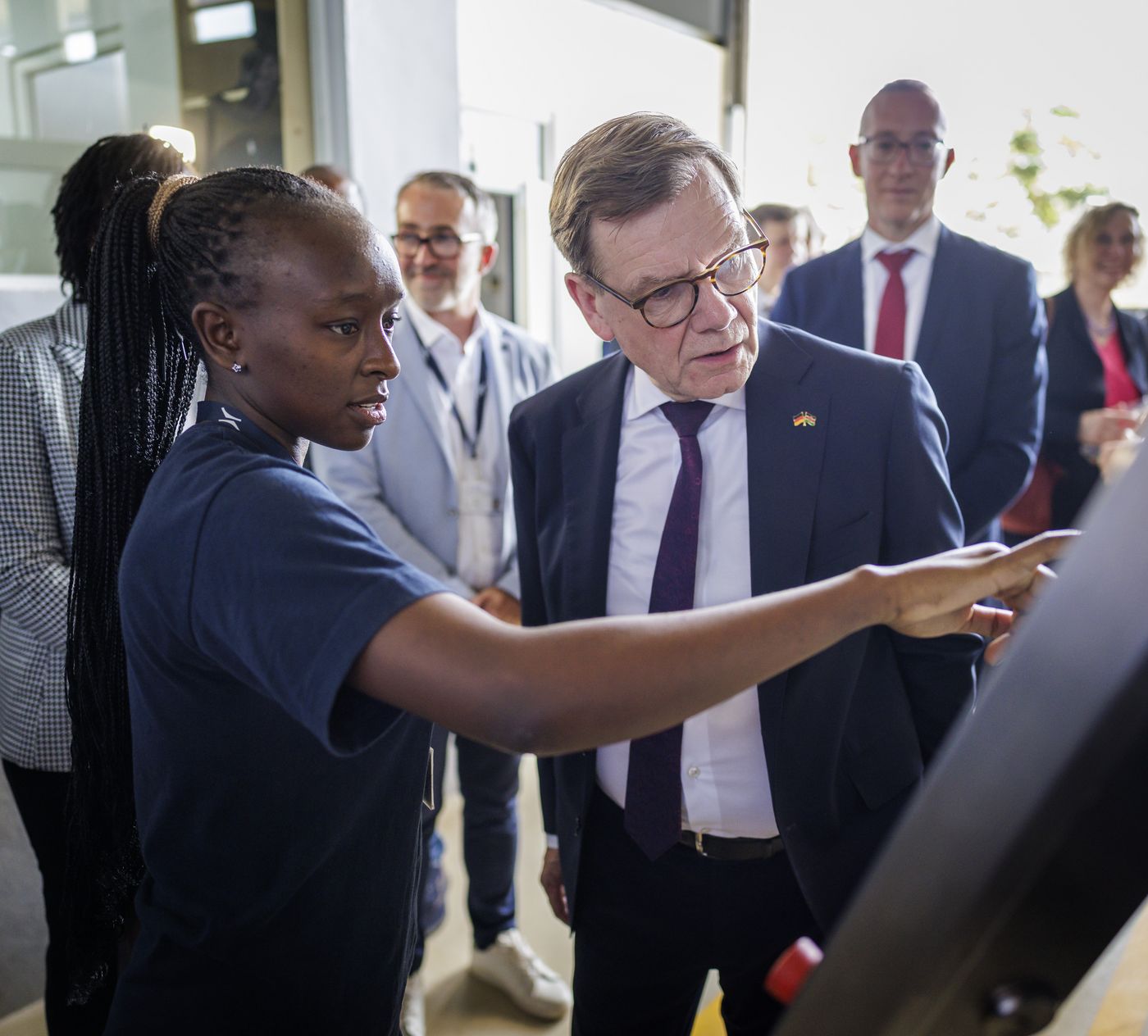
Johann Wadephul (CDU), Federal Minister for Foreign Affairs, is visiting the trainees of Krones, a company which trains mechatronics engineers in Nairobi as part of its dual training programme.
© picture alliance / AA/photothek.de | Thomas Koehler
By 2050, Africa is expected to account for around a quarter of the global working-age population, whereas the working-age population in many European countries is shrinking. In recent years, the German federal government has become increasingly open to recruiting workers from third countries such as India, for example through bilateral migration agreements and reforms to migration legislation. However, key countries of origin for migrant workers, such as Vietnam, have themselves been ageing for some time, and in India too, the current labour surplus is expected to decline over the long term. Across sub-Saharan Africa, many countries are experiencing sustained growth in their working-age populations and are therefore likely to become key countries of origin for the recruitment of skilled workers in the future. So far, however, the potential to attract workers from the young societies of sub-Saharan Africa to the labour markets of Europe’s ageing societies has barely been addressed at the policy level.
Labour and Education Migration from Africa Is Growing, but Germany Is Making Only Limited Use of This Potential
A rise in migration for employment, vocational training, or study is already evident today, when for example looking at the corridor between African countries and Germany. This trend is reflected in the sharp increase in the number of visa applications processed by German embassies in African countries for the purpose of employment: Between 2019 and 2025, this number almost quadrupled, rising from around 7,860 to 29,415. A large share of this increase is attributable to the rise in the number of visa applications for vocational training and further education, which increased from 1,318 in 2019 to 7,531 in 2025. These figures do not include asylum applications or family reunification. They refer to visa applications and primarily show how sharply demand has grown, but they do not indicate how many visas were granted or how many people actually moved to Germany. Available evidence suggests that the rejection rate for visa applications from these countries is significantly higher than that for applicants from other regions of origin.
According to Eurostat data, Germany was not the leading destination within the EU for migration from African countries between 2014 and 2023. It ranked fourth in terms of the total number of arrivals, fifth for labour migrants, and at least third for education migrants. At the same time, it is important to note that the majority of African migrants continue to migrate within the continent, even as migration from African countries to Germany and Europe gradually increases.
While North African countries top the list of African countries of origin for labour and education migration to Germany and are the main focus of European-African cooperation, the recruitment of skilled workers from sub-Saharan African countries is less pronounced. However, inflows from individual countries such as Kenya, Ghana, and Cameroon are growing, albeit from a significantly lower base.
Kenya: Marked Rise in Visa Applications Processed for Nurses
To date, German and European migration cooperation has primarily focused on cooperation with state institutions in partner countries, usually in connection with demands for improved cooperation on the return of nationals required to leave the country. One example is the bilateral migration agreement with Kenya, concluded in September 2024 at the initiative of former German Chancellor Olaf Scholz. Although it is still too early to assess the effects of the agreement, the number of visa applications processed for Kenyan nurses rose sharply, from 3 in 2022 to 389 in 2025.
Ghana: Growing Interest in Studying in Germany
Ghana is considered a priority country for the recruitment of skilled workers to Germany. Interest in studying in Germany is also growing significantly: Whereas 621 visa applications for study purposes were submitted in 2019, this figure had more than doubled to 1,340 by 2025. In the winter semester of 2024/2025, there were 2,918 Ghanaian nationals enrolled at German higher education institutions. A bilateral migration agreement with Ghana has been under discussion for some time and should be finalized in order to make better use of Ghana’s comparatively strong education base, also for the immigration of already qualified professionals to Germany.
Cameroon: Traditionally High Student Numbers and Significant Growth in Vocational Training
Cameroon has long been an important country of origin for students in Germany, ranking fourth among African countries in the winter semester of 2024/2025 with 6,837 students. This is due in part to the fact that the Cameroonian high school diploma often qualifies students to study at German universities. What is new is the significant increase in labour migration, particularly in the area of vocational training. According to statistics from the Federal Employment Agency (BA), the number of Cameroonian nationals in vocational training positions in Germany rose from 950 in 2019 to 5,260 in May 2026. A remarkable aspect of this trend is that the increase is likely attributable both to the initiative of Cameroonian migrants themselves and to support from private recruitment agencies and diaspora networks.
This raises a political question that is not unique to Cameroon: If such migration corridors emerge without state intervention, what role do non-state actors play, and what is the state’s responsibility? The state’s role is not to create demand for labour, which clearly already exists, but to provide what individual initiative and private recruitment agencies cannot. This includes, for example, supporting the recognition of qualifications and pre-departure training through dialogue with countries of origin. At the same time, corridors such as the one between Cameroon and Germany carry an increased risk of exploitative recruitment practices, such as high agency fees paid by the migrants. This makes it all the more important to run information campaigns in countries of origin to educate people about regular migration channels, qualification requirements, and recognition options, while also warning them about unscrupulous intermediaries, excessive costs, and the risks of exploitation in Europe. Only then can emerging pathways for regular labour and education migration expand sustainably and fair and be shaped in ways that have positive development impacts in countries of origin.
Positive Development Impacts of Regular Migration from Africa
The added value of regular labour and education migration for Germany is clear. However, labour mobility can present both opportunities and risks for the countries of origin, depending on the sector and the specific arrangements. If properly managed, labour mobility can bring considerable benefits, and migrants themselves are the most direct beneficiaries. In Germany, it is possible for them to earn several times more for the same work than they could in their country of origin. Through remittances, this private benefit can also have positive development impacts in countries of origin. In low- and middle-income countries, remittances significantly exceed official development assistance (ODA). In addition, migration can have non-financial effects, such as when the prospect of migration strengthens incentives for education in the country of origin (“brain gain”). Positive development effects can also arise when migrants circulate between countries or return after a few years and apply newly acquired skills in their countries of origin (“brain circulation”).
The widespread concern about the loss of scarce skilled workers (“brain drain”) must be taken seriously in principle, but in many cases it does not reflect labour market conditions across sub-Saharan Africa. This is particularly true of skilled workers who emigrate because they cannot find suitable work in their country of origin or are employed below their level of qualification. Even in cases where people emigrate due to limited training opportunities in their country of origin to pursue higher education or vocational training in Germany, this does not necessarily result in a loss of skilled workers for their country of origin. Problems arise when the most highly qualified individuals are systematically recruited away by other countries, for example when the emigration of healthcare professionals destabilizes already fragile health systems. However, even in these cases, the picture is more complex than the debate suggests. Ghana, for instance, is on the WHO’s “Workforce Support and Safeguards List” to protect against active state recruitment, as do many countries with strained health sectors. At the same time, it is now training more nursing staff than the domestic labour market can absorb, partly because the Ministry of Health has expanded training programmes and authorized private providers. Ghana is expected to be taken off the Safeguards List when it is updated in 2026.
Options for Promoting Education and Labour Migration from Sub-Saharan Africa
The trends described will not become established on their own; the structural barriers to accessing the German labour market are still too great. This applies in particular to recruitment from sub-Saharan Africa, where functioning ecosystems for education and labour migration to Germany are almost non-existent. Obstacles include lengthy visa issuance and qualification recognition procedures. The “Work and Stay” agency planned by the Federal Government is intended to address these problems through the further digitalization and centralization of processes, although agreement within the Federal Government on its structure has yet to be reached. In any case, well-managed and successful recruitment of skilled workers will require a comprehensive approach that also addresses conditions in countries of origin, including in Sub-Saharan Africa.
German development cooperation has stepped up such measures in recent years. For instance, the Federal Ministry for Economic Cooperation and Development (BMZ)’s programme “Shaping development-oriented migration” and the Centres for Migration and Development in Ghana and Nigeria have provided information on opportunities for regular labour migration and vocational training in Germany. However, many of these projects have been unable to lift structural barriers, such as the recognition of qualifications and vocational certificates obtained in sub-Saharan African countries or to serve as a platform to connect with the BA and German employers. In view of potentially dwindling funding, it would be sensible to set priorities for the migration related development cooperation: For instance, there should be greater investment in training capacities and in the expansion of mobility pathways for trainees to Germany. In this way, local skills levels can be improved, benefiting potential migrants and those who wish to remain in their country of origin. Development cooperation projects should be linked even more closely to diaspora activities and engagement in the field of technical and vocational education and training. In doing so, priority should be given to high-performing, predominantly public–private TVET providers in countries such as Ghana and Kenya. It will remain important not to turn development cooperation solely into a tool for recruiting skilled workers to Germany, as this would also contradict the requirement for it to qualify as ODA.
German companies also need more support: Recruitment from sub-Saharan Africa involves high costs and information barriers that deter small and medium-sized enterprises in particular, creating a coordination problem that justifies state support. The WE-Fair Skilled Workers Alliance, initiated by the BMZ, can help raise awareness among companies about fair recruitment and, with the involvement of non-state actors, develop practical cooperation models. Companies that are already active in the markets of the relevant countries of origin, or that already recruit workers in a fair manner, could play a particularly pioneering role in this regard.
David Kipp is a Researcher and Emma Landmesser is a Research Assistant in the project “Migration and Displacement in a Shifting Global Order” which is funded by the Federal Ministry for Economic Cooperation and Development at the German Institute for International and Security Affairs (SWP).
Prof Dr Tobias Heidland is Professor of Economics at Christian-Albrechts University, Director of the ‘International Development’ Research Centre at the Kiel Institute and Co-Project Director of Megatrends Afrika.
The Future of African-European Relations examines how the two regions can build stronger partnerships in an era of geopolitical fragmentation, economic competition and changing global power dynamics. It is a collaboration between the African Futures & Innovation Programme at the Institute for Security Studies (ISS), the Federation of German Industries (BDI), the Hanns Seidel Foundation and the Megatrends Afrika consortium, comprising the German Institute for International and Security Affairs (SWP), the German Institute of Development and Sustainability (IDOS) and the Kiel Institute for the World Economy. Drawing on the expertise, research and analytical frameworks of the participating institutions, the project explores how different global futures could shape trade, investment, development cooperation and shared prosperity between Africa and Europe – and it aims to develop policy recommendations for different stakeholders.