How South Africa and the EU Can Strengthen Cooperation on Minerals
Megatrends spotlight 82, 01.09.2026Both the EU and South Africa seek to reshape critical raw materials supply chains. The EU aims to reduce dependencies on China, while South Africa seeks to create jobs. Melanie Müller explains how their interests can be aligned for closer cooperation in the minerals sector.

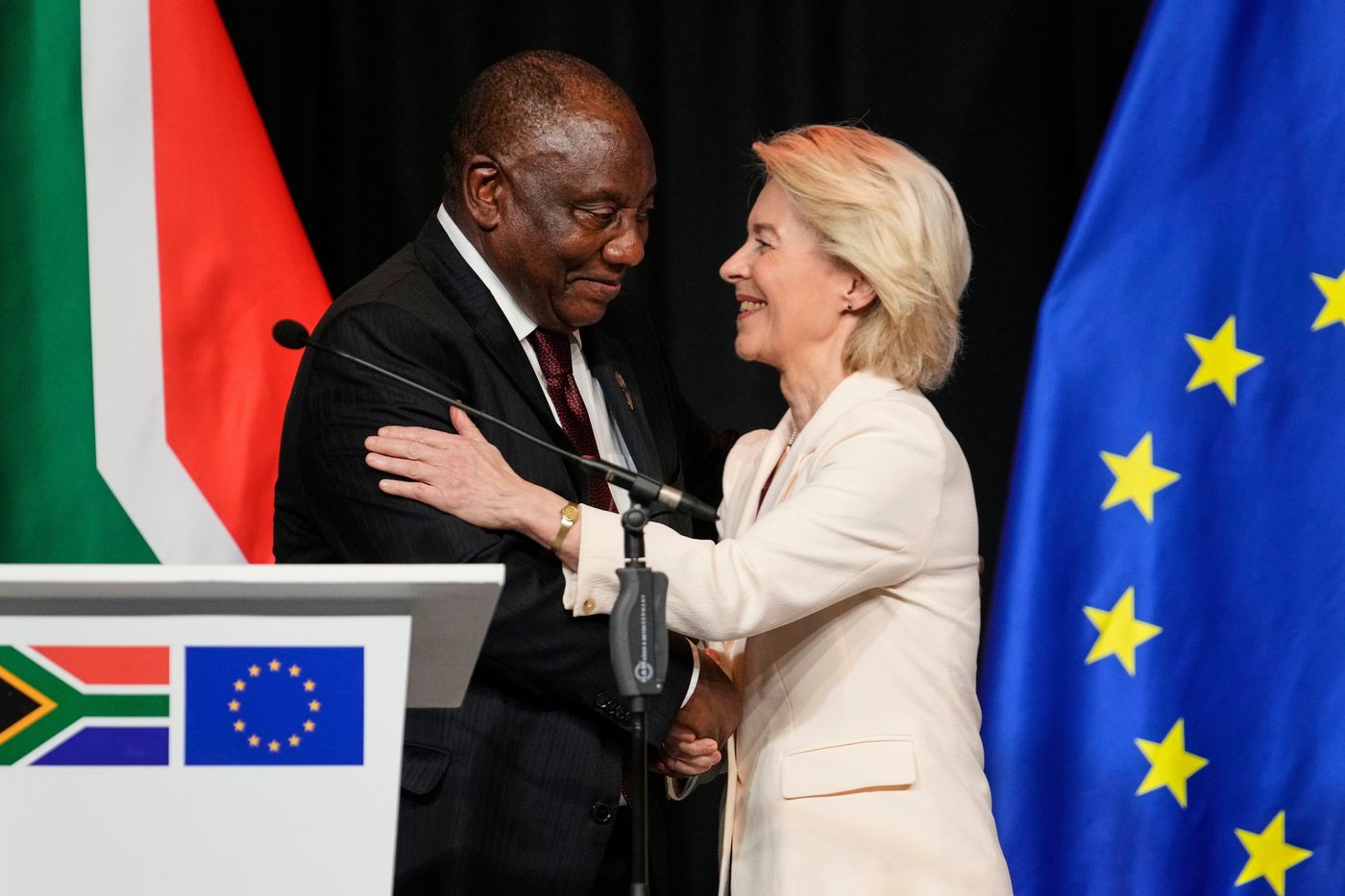
South African President Cyril Ramaphosa and European Commission President Ursula von der Leyen shake hands at the end of their media conference in Johannesburg, South Africa, November 20, 2025.
© picture alliance / ASSOCIATED PRESS | Themba Hadebe
South Africa is one of the most important European Union (EU) trading partners in Africa. It is also an increasingly relevant partner for the EU in minerals cooperation, particularly because the country possesses raw materials that are essential to European industry.
In November 2025, on the margins of the G20 summit, the EU and South Africa signed a Memorandum of Understanding (MoU) to cooperate on sustainable value chains for minerals and metals. This partnership aims to identify joint projects along all stages of the minerals value chain – exploration, extraction, refining, and recycling of minerals and metals. At the same summit, the South African government and the EU signed the Clean Trade and Investment Partnership (CTIP), complementing the MoU by providing a broader framework for cooperation designed to facilitate trade and investment in clean supply chains by identifying and addressing regulatory challenges. Both parties could benefit from long-term cooperation in the minerals sector while further strengthening their economic partnership in areas of shared interest.
While the framework could strengthen the economic partnership, further groundwork is needed to ensure successful long-term cooperation. The main challenge is not only to bring together companies from both sides that share a common commitment, but also to support them in developing bankable projects along the supply chain. Both the EU and South Africa have developed financial instruments that could support innovative projects. They should now also work together to identify synergies and potential gaps in financial cooperation and make these tools more transparent and accessible.
European Interests: Diversifying Supply Chains and Building New Partnerships
Through the Critical Raw Materials Act (CRMA), the EU has set a goal of securing its supply of raw materials by 2030, against the backdrop of intensifying geopolitical competition. A central objective is to reduce dependence on China, as a significant proportion of these minerals is processed in Chinese smelters and refineries before entering the EU. Mining, however, generally takes place in resource-rich countries, many of which are in Africa. Through the CRMA and new partnerships with these countries, the EU aims to establish direct supply relationships that bypass China. In recent years, more countries have become active in this “new geopolitics of minerals supply chains”, thereby increasing the competition. The United States, particularly under President Donald Trump, has taken a transactional approach to securing new raw materials deals. The Gulf states, particularly the United Arab Emirates and Saudi Arabia, are also actively seeking new raw materials partnerships across Africa.
The EU’s raw materials diplomacy must therefore be understood not only as an industrial policy tool, but also in the context of intense competition among states for cooperation with resource-rich partners. With the CRMA, the EU has succeeded in uniting its member states in a common strategy to secure raw materials. At the heart of the CRMA are the 17 so-called strategic raw materials, which are essential for the green transition, digitalization, defence, and space exploration. Their global production can only be increased to a limited extent, while demand is growing rapidly. The EU aims to increase the extraction, processing, and recycling of these materials within the EU, while also diversifying its supply relations. According to the goals in the CRMA, not more than 65 per cent of any given strategic raw material should originate from a single third country.
The EU has established various instruments to support its external raw materials policy. In addition to the raw materials partnerships, which are non-binding declarations of intent, raw materials projects can apply to be included on a list of “strategic projects”. The first list of strategic projects outside the EU was published in June 2025 and included five projects in Africa, including one in South Africa. Strategic projects do not automatically receive financial support, but the designation might help companies access finance more easily. At the same time, the EU has long struggled to develop financial instruments at the European level for the minerals sector. Companies could apply for funding through individual European member states. Global Gateway funding is another option, but it was not specifically designed for the minerals sector and provides only limited funding opportunities for such projects.
In December 2025, the Commission presented the ResourceEU Action Plan to address this issue. The plan provides for the creation of a European Critical Raw Materials Centre to steer and co-finance strategic projects. It includes a matchmaking mechanism to connect suppliers with EU buyers and facilitate offtake agreements, although its implementation remains a work in progress.
South African Interests: Green Industrialization and Local Value Creation
Several resource-rich states have recognized this geopolitical competition in the minerals sector as an opportunity and are actively shaping their raw materials policies accordingly. Strategies range from significant intervention in the raw materials sector – such as restricting the export of unprocessed raw materials – to more market-liberal policies. South Africa is among the resource-rich African states that favours a more market-liberal approach. The South African government intends to reverse deindustrialization in the South African economy and create new jobs in the process. Local value creation is of particular importance for South Africa as the country is confronted with persistently high unemployment. This is particularly important in the mining sector, as South Africa’s energy transition is expected to result in job losses in the coal industry. Green industrialization is therefore also seen as an opportunity to boost industrial production in various sectors.
Unsurprisingly, the raw materials sector has been identified as one of the key sectors in South Africa’s 2026 Industrial Development Strategy. Compared with other resource-rich African countries, South Africa has a large, well-developed mining sector and well-established institutions that support new project development. South Africa’s Industrial Development Corporation (IDC) plays an important role. The IDC has funded various feasibility studies to expand raw materials supply chains and link them with other sectors. It also provides funding for projects in the raw materials sector itself. These include the “Junior Mining Exploration Fund”, designed to support exploration projects in the raw materials sector. Funding opportunities are also available for other parts of the value chain.
The South African Department of Mineral and Petroleum Resources (DMPR) has also published its own “Critical Minerals and Metals Strategy” in 2025. It sets out an ambition to move from exporting raw materials towards becoming a regional hub for smelting, processing, and advanced manufacturing in the Southern African Development Community. The strategy defines “criticality” according to indicators such as export significance, industrial importance, national-security relevance, and job creation. The strategy has a strong focus on value addition and localization, research and development, and the creation of a skilled workforce.
Building and Backing an Ecosystem of South African and European Companies
The successful implementation of these strategies depends on several prerequisites. South Africa must continue to improve its energy and transport infrastructure, as this is essential for developing and expanding new value-added infrastructure. Although reforms in these sectors are progressing more slowly than planned, continued progress is important for building stable, long-term economic partnerships. The successful implementation of these strategies will also depend on South Africa’s ability to overcome other governance challenges, such as “limited institutional capacity, regulatory uncertainty, and weak coordination across government”.
However, further steps are needed to establish new value chains between South African and European stakeholders. A key joint task for European and South African policymakers is to bring together companies from both regions and across sectors that have complementary interests. In the past, the EU struggled to attract sufficient interest from European companies to engage in these partnerships, or to translate political declarations of intent into concrete cooperation. Nevertheless, many European companies are increasingly recognizing that long-term investment in diversification pays off, despite higher short-term costs; however, they also need greater political support.
To be successful, such arrangements need to balance the interests of both the EU and South Africa. One advantage is that the EU and South Africa already cooperate in other sectors linked to the raw materials sector, such as energy and health. The task is nevertheless substantial: An ecosystem of companies must be established that brings together, for example, South African mining companies; European and South African processing firms; buyers in South Africa and the EU; and small and medium-sized companies. These companies must identify bankable projects along the supply chain. A further advantage is that many European companies are already present in South Africa or have economic ties with South African companies, and that German and South African institutions have already tried to bring them together. Such projects can succeed only if they are backed by financial instruments.
Both South Africa and the EU have established funding mechanisms to develop new supply chains. These instruments may even be complementary, enabling projects along the supply chain to receive financial support from both sides. The EU and South Africa should leverage the CTIP cooperation to identify more precisely these opportunities and potential funding gaps, and to make funding opportunities more transparent, thereby increasing the likelihood of successful cooperation.
Opinions expressed reflect the views of authors, not necessarily those of the organisations partnering in the project, The Future of African-European Relations.
Dr Melanie Müller is a researcher and deputy head of the Africa and Middle East Research Division at the German Institute for International and Security Affairs (SWP).
The Future of African-European Relations examines how the two regions can build stronger partnerships in an era of geopolitical fragmentation, economic competition and changing global power dynamics. It is a collaboration between the African Futures & Innovation Programme at the Institute for Security Studies (ISS), the Federation of German Industries (BDI), the Hanns Seidel Foundation and the Megatrends Afrika consortium, comprising the German Institute for International and Security Affairs (SWP), the German Institute of Development and Sustainability (IDOS) and the Kiel Institute for the World Economy. Drawing on the expertise, research and analytical frameworks of the participating institutions, the project explores how different global futures could shape trade, investment, development cooperation and shared prosperity between Africa and Europe - and it aims to develop policy recommendations for different stakeholders.
