Europe’s Visibility Dilemma in Tunisia
Megatrends spotlight 76, 15.07.2026In Tunisia, European-funded projects frequently remain under the radar, whereas Chinese initiatives are highly visible and welcomed. Isabelle Werenfels explores why European cooperation tends to be deliberately downplayed and how that can be changed while avoiding the risk of political backlash.
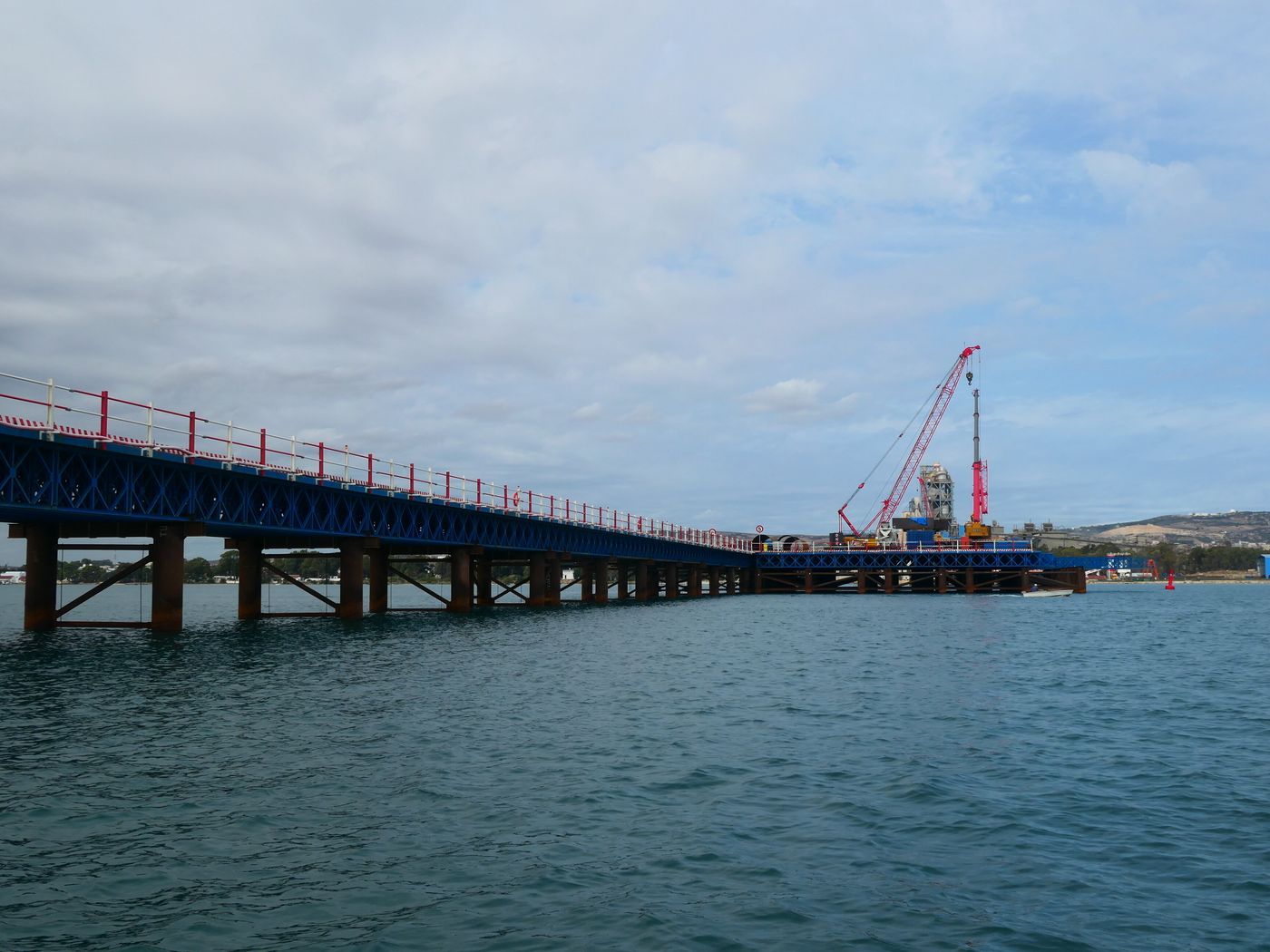
The pier bridge and steel construction platform are part of the infrastructure project in Bizerte. Despite being financed by the European Investment Bank, the project is referred to as the 'Chinese bridge', Bizerte, Tunisia, 25 September 2025.
© picture alliance / Xinhua News Agency | Huang Ling
When Tunisians these days proudly refer to the “Chinese Bridge” under construction in the coastal town of Bizerte, it is unclear how many know that it is in fact financed by the European Investment Bank. Similarly, no Tunisian or foreign journalist, no civil society actor, and barely any officials I spoke to during a recent visit were aware that two large Tunisian water reservoirs are being expanded thanks to German-funded dam extensions. Nor did they know that several wastewater treatment plants have been built with German grants, or that the large plant to be renovated for Greater Tunis is part of a joint European project. The same pattern can be seen elsewhere. France’s donation of 165 buses in 2025 largely went unnoticed. By contrast, the arrival of 461 Chinese buses generated extensive media coverage and considerable official fanfare. The opening of Tunisia’s second Confucius Institute in May 2026 attracted similar attention.
There is a striking mismatch between European visibility and actual engagement. This is all the more remarkable given that Europe remains by far Tunisia’s most important economic partner. It accounts for 85 per cent of foreign direct investment, provides budget support, and finances numerous projects through grants. Chinese engagement, by contrast, is largely credit-based and thus adds to Tunisia’s already strained public finances.
So, is Beijing simply better at selling itself? That may be part of the explanation. More important, however, may be the fact that Beijing has no reason to downplay what it is doing, whereas for the European Union (EU) and many of its member states, publicizing their engagement has become increasingly complicated.
From Darling to Meddler
While China has gained in visibility and popularity, Europe has struggled with both. Perceptions of European engagement after 2011 were initially broadly positive. Brussels championed Tunisia as the Arab world’s democratic beacon, and Tunis could count on a democratization dividend in return. Yet Europe’s extensive presence gradually fuelled sensitivities over sovereignty. Narratives of European exploitation and interference were evident, for instance, in resistance to negotiating a free trade agreement with the EU in the late 2010s. More recently, European-backed green hydrogen projects have sparked protests amid concerns that they could deplete water resources, lead to land-grabbing, and pollute Tunisia for Europe’s benefit.
Tunisia’s president, Kais Saied, has drawn on such anti-Western and sovereignty-centred sentiment and frequently alludes to hidden networks seeking to destabilize Tunisia. Since 2023, dozens of opposition figures have been accused of conspiring against the state with foreign support and sentenced to lengthy prison terms.
Fear of being accused of meddling in domestic affairs has kept European policy-makers from reacting more decisively to the country’s massive democratic backsliding – arguably, it has also provided them with an excuse for inaction. Initial ideas in Brussels to circumvent the president faded as migration became a key domestic policy issue across Europe. The MoU concluded between the EU and Tunisia in 2023, with a potential funding value of up to EUR 1 billion, was primarily an effort to appease the Tunisian president to secure his cooperation with Europe on migration. Unsurprisingly, it was poorly received by civil society. Only a few months later, Saied returned EUR 60 million previously transferred by Brussels to Tunis, arguing that it was insufficient compensation for Tunisia’s cooperation on migration and that the country’s sovereignty was not for sale. Since then, significant portions of the EU’s promised aid have remained delayed, stalled, or undisbursed.
Then came the war in Gaza, further straining relations between Tunisia and Europe. European politicians’ largely uncritical backing of Israeli military action gave another boost to the Tunisian president’s populist rhetoric. Criticism of European double standards resonated strongly among the population and was not limited to France. Germany, which after 2011 had built substantial soft power in Tunisia through hundreds of projects and was by far the preferred partner for infrastructure development, now faced calls for the expulsion of its ambassador. For European diplomats it was no longer feasible to invoke international law or human rights without risking a public outcry in Tunisia. The popularity of Europe reached a low point in 2024.
Fears of a Wrong Move
Although perceptions of Europe and its status as Tunisia’s most important partner have improved in recent polls, political hurdles to greater visibility remain high. In late 2025, the president summoned the Head of the EU Delegation for having met with the trade union Union Générale Tunisienne du Travail (UGTT). The days when the EU Delegation in Tunis led communication on joint projects and explained the potential benefits of the planned trade agreement in town hall meetings are long gone. These days, Europeans are struggling even to visit, let alone inaugurate, the projects they are financing, as such visits require complicated administrative procedures and usually exclude the press. This is, ultimately, the result of another development that is separate from Euro-Tunisian relations but has a strong impact on them: the president’s authoritarian grip on the country. Ministries’ actions are constrained by fear of making a wrong move. Although this affects many, if not most partners, Europeans are particularly impacted. Tunisian officials and the media appear less hesitant to publicly associate themselves with Chinese projects and to highlight them. As a result, the aforementioned bridge – built by a Chinese company but financed by Europe – is presented simply as a Chinese project.
Consequently, Europeans are increasingly reluctant to claim credit for what they do in Tunisia. Instead, they retreat to the safer terrain of grand (regional) initiatives such as ELMED and the Pact for the Mediterranean, where visibility is less politically sensitive and responsibility is more diffuse. There is little risk in promoting an undersea power cable connecting Tunisia and Italy, and potentially providing energy security benefits on both sides of the Mediterranean. Communication on the Pact for the Mediterranean, a new EU initiative to deepen ties with its Southern Neighbourhood, is usually so abstract that protests in front of embassies are unlikely. Even experts struggle to understand how it relates to earlier frameworks such as the Barcelona Process, the European Neighbourhood Policy, and the Union for the Mediterranean. In fact, the Pact has so far received only modest attention in Tunisia.
Strategic Communication: From Lofty to Concrete
Against this rather complex backdrop, a central question arises: How can Europeans address the dilemma that they want their cooperation to generate visibility and soft power, but do not want to provoke political backlash? There are no easy solutions, but there are a few promising avenues. The bottom line is that Europe should not hesitate to showcase infrastructure cooperation that brings tangible benefits to the population. After all, Europe is on relatively firm ground here: It would be rather difficult for the Tunisian president to portray sewage treatment plants as foreign interference.
First, and more concretely, Europe should avoid lofty statements about future EU-Tunisia cooperation and instead highlight what has been accomplished, namely concrete results. In a long interview with the EU Ambassador this spring, readers learnt only after pages of bureaucratic EU cooperation jargon that the Bizerte bridge is financed by Europe and that the EU has funded flood protection and solar power projects in marginalized regions. Similarly, the website of the German development bank KfW contains impressive presentations of German-funded projects, including a desalination plant that provides all of Djerba with drinking water. But unless you read English well and know where to look, you are unlikely to find them. Such projects benefit Tunisian citizens directly and strengthen European soft power, but only if they are visible and clearly attributed to Europe.
Second, given the difficulties Europeans face with inaugurating projects and getting coverage for them in Tunisian media, there is a need for creative ways to showcase EU projects. Dry Facebook posts will not do the job. Humour often does. The EU Delegation’s New Year’s card featuring the “Chinese Bridge” was a nice tongue-in-cheek idea, but probably only for insiders who knew who had actually financed it. Why not place the bridge at the centre of a prominent “building bridges” campaign that also features ELMED and Erasmus+. Why not also involve diaspora actors, true “bridge-builders”, in such campaigns. They are less likely to be labelled neo-colonial. A Tunisian-French comedian joking about the “Chinese-European bridge” could go viral. So could a German-Tunisian engineer explaining sewage treatment in a witty mix of Tunisian Arabic and German.
Third, Europeans should be more straightforward about their interests and take responsibility for errors of the past. Seeking to obscure when cooperation is primarily about migration, as was the case with the 2023 MoU, or arguing that there are no European double standards on Ukraine and Gaza risks insulting Tunisians’ intelligence. It is also essential to acknowledge and apologize for things that clearly went wrong, such as earlier European waste dumping in Tunisia. Europe’s standing could also get a real boost if Brussels were to publicly announce a concrete plan to replace the chemical plant in Gabès, whose toxic emissions have long affected the health of the city’s population. This would admittedly require substantial grants and credits. But inaction may give China another opportunity to present itself as the benefactor, even if it is Tunisia that must pay for it.
Finally, the Chinese-built bridge raises an issue that goes beyond visibility and communication. It concerns how European funders can avoid situations in which European aid and development finance ultimately bankroll major contracts awarded to Chinese companies in Europe’s neighbourhood. In this context, giving European (infrastructure) projects more visibility is also in Tunisia’s interest. Failure to do so inadvertently fuels right-wing populist narratives in Europe that question the value and tangible benefits of foreign aid and may well result in funding cuts.
Dr Isabelle Werenfels is a Senior Associate in the Africa and Middle East Division at SWP.