Transactional Deal-Making: The Promise and Perils for Peace Mediation
Megatrends spotlight 86, 24.09.2026Transactionalism elicits strong views on both its utility and impact on peace mediation. Narine Karapetyan and Karoline Eickhoff argue that in order to better understand transactional approaches and their effects, we need to focus on the shifting role of third-party interests.
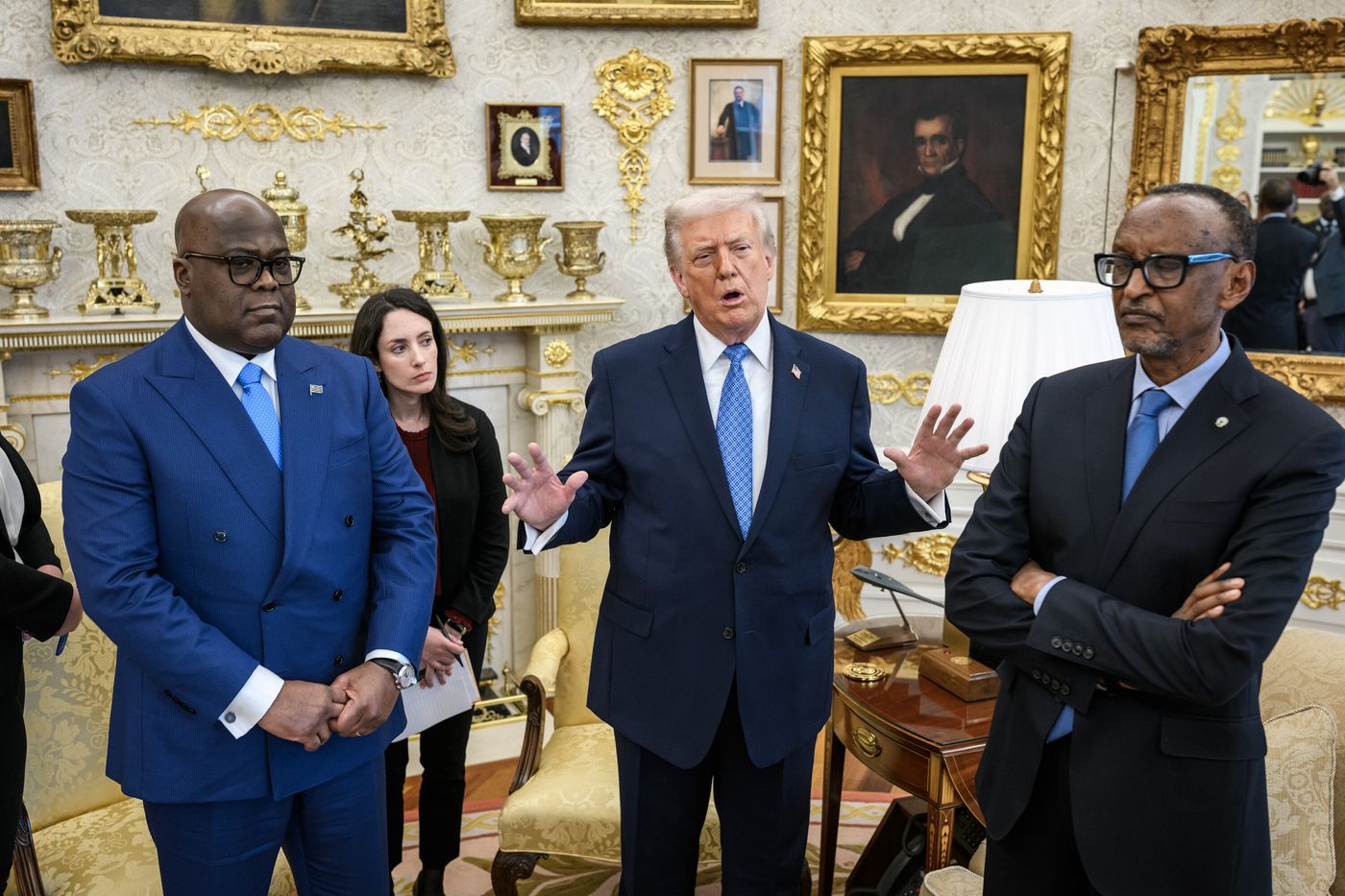
President Felix Tshisekedi of the Democratic Republic of the Congo, President Donald Trump of the United States of America and President Paul Kagame of the Republic of Rwanda meet in the Oval Office on December 4, 2025, Washington D.C.
© picture alliance / Photoshot | -
Transactional approaches are becoming more prevalent in global politics. Recently, transactionalism has been widely associated with the US administration and its approach to negotiations. Significantly shaped by President Donald Trump’s experience of commercial dealings in New York real estate, the transactional mindset has come to characterise his approach to international diplomacy. Indeed, in Trump: The Art of the Deal, he elaborates on his transactional negotiation style: “My style of deal-making is quite simple and straightforward. I aim very high and then I just keep pushing and pushing and pushing to get what I’m after.”
The transactional approach has also been used in the name of brokering peace deals. The peace agreement signed in Washington in December 2025 between the Democratic Republic of the Congo (DRC) and Rwanda is among the latest “minerals-for-security/peace” deals brokered by the US administration. As part of the Washington Accords, it comes as a package deal together with a regional economic cooperation agreement and bilateral economic deals between the conflict parties and the US, which grants Washington sweeping access to Congolese critical minerals.
Washington's imposing approach not only in this case but also in others has raised questions among practitioners, policymakers, and researchers about how these ongoing dynamics will continue to alter the practice of peace mediation. Transactional deals have come increasingly into the spotlight, with opinions about them sharply divided. Proponents argue that transactional approaches offer pragmatic and supposedly more honest pathways to reaching short-term deals in protracted conflicts where nothing else has worked. Critics contend that such approaches crudely prioritise optimising short-term gains for political and economic elites at the expense of addressing the root causes of conflict and establishing the structural conditions necessary to reach more sustainable agreements.
As the jury is out on the merit of transactionalism in peace mediation and as opinions are largely coloured by President Trump’s approach, we argue that the main concern about transactional deal-making has less to do with the means than the ends. Although this approach is not necessarily incompatible with broader peace mediation goals, there is little to indicate so far that they realistically serve as a first step towards a more comprehensive peace process. Drawing on the DRC-Rwanda case, we posit that there is a real risk of third parties co-opting peace processes to advance their own material interests rather than addressing the conflict between the parties involved. This should caution us against reinforcing the perception that transactional deal-making is simply a form of mediation that can be more effective.
Transactionalism is Part and Parcel of Dispute Resolution Processes
Transactionalism is not limited to President Trump’s approach but has long been a part of broader conflict resolution practice. Parties engage in “give and take” negotiation driven by their own interests, hard bargaining, and prioritising their immediate narrow gains over a mutually agreeable solution. This is to be expected and part of the natural ebb and flow of parties eventually arriving at some kind of sustainable agreement. For an agreement to be reached, third parties typically intervene to exert a degree of leverage and structure to the negotiations. Conflict parties are often very entrenched and need both new impetus and support through third-party intervention to overcome any stalemates.
Although this role requires some level of impartiality to engage with both sides, third parties have regularly sought not only to promote conflict resolution but also to advance their own interests in the process, based on cost-benefit calculations. Particularly during the Cold War, states strategically pursued their foreign-policy interests in mediation processes rather than acting solely out of a sense of moral obligation or with the primary objective of resolving the conflict. One could indeed debate whether third-party interests have always been a dominant factor in peace negotiations or if there was ever a time when peace itself was the primary goal and third parties were content with the status gains of playing a constructive role.
While mediation depends on the consent of the conflict parties, initiatives that venture into the “grey area” of high-powered diplomacy and coercion did not necessarily start with the current US administration either. In the past, third-party mediators relied on both carrots (incentives) and sticks (pressure) to influence the mediation outcome. Prominent examples include George Mitchell’s mediation in the Northern Ireland peace process and Richard Holbrooke’s role in the Dayton Agreement. By and large, these agreements have been regarded favourably, as they produced outcomes that addressed the pressing circumstances of the time. Notably, the majority of African mediation initiatives over the past two decades have not simply facilitated negotiations between the parties but have negotiated directly with the conflict parties to elicit concessions and make transactional arrangements.
We are Currently Entering a Demonstrably Different Terrain of Transactional Mediation
Although the trade-offs between the different mediation objectives and principles are not new, the transactional approach adopted by the US administration takes the issue of third-party interests in peace negotiations to another level – one that goes beyond even the most cynical conception of third-party intervention and stretches even the broadest definitions of mediation. The effects are somewhat paradoxical, highlighting the tension between prevailing perceptions of transactional deal-making and the situation on the ground.
The DRC-Rwanda process is a case in point. On the one hand, the parties continue to wage violent conflict. The latest report by the Group of Experts on the DRC found that “both parties pursued their strategic objectives amid ongoing hostilities”, shedding doubt on the credibility of their commitment to negotiating peace. Human rights violations continue to be committed by the armed forces, largely unabated by US domineering rhetoric. What is increasing, however, are US advances into the Congolese minerals sector under the Strategic Partnership with the DRC government. Moreover, the Congolese government has used this partnership for the purpose of domestic campaigning and justifying attempts to make constitutional changes that would allow President Félix Tshisekedi to seek a third term in office. Amid the sweeping US sanctions against Rwanda, including those targeting the armed forces and actors in the mining sector, Foreign Minister Olivier Nduhungirehe has criticised the “increasingly blatant” bias of the US in the mediation process. Washington has done little to dispel such criticism, which has raised concerns that convening the negotiations is merely a means for the US to advance its own material interests. Indeed, there is much to suggest that the US has become a co-equal participant in, and material beneficiary of, the negotiations, alongside the conflict parties, rather than serving merely as convener.
On the other hand, although most actors working on peace and conflict in the region disapprove of US motivations, the broader perceptions of the US engagement are not straightforward. Some still view Washington’s transactional approach as potentially more effective than other initiatives and as capable of getting the protracted conflict unstuck. For now, the Congolese and Rwandan side remain present at the negotiation table and have reasons to demonstrate a constructive stance. In a decades-long conflict in which previous initiatives have yielded no substantive results, this should count for something. What is often pointed out as an advantage of such transactional deals in a changing global political environment is their supposedly pragmatic character. Indeed, in a world characterised by growing geopolitical competition, many governments are adapting their foreign-policy priorities, putting stronger emphasis on own material interests. Institutions that have shaped peace-making since the Cold War are losing ground. The broader framework of peace mediation which postulates principles such as institutionalised procedures of negotiated conflict settlement, is fraying. Under these conditions, some third parties dropping even the pretence of centring the interests of the parties in conflict appears to be a natural consequence of the “new realities”, in which principles once held are now perceived as a hindrance to reaching pragmatic agreements.
Conclusion
The appeal to pragmatism merits closer consideration. Pragmatism requires assessing concepts and approaches based on their practical, real-world effects rather than dogma and fixed beliefs. From this perspective, transactionalism is a means to achieving different ends, and short-term goals in deals are not necessarily problematic.
It is crucial, however, to consider how the intervention approach adopted by a third party is connected to their objectives before drawing any conclusions about its utility and impact on peace mediation. When third parties seek primarily to advance their own interests, the question of what constitutes mediation “success” may not be about conflict resolution. Instead, the third party may have other objectives in mind, and the chosen approach provides a pragmatic pathway to achieving them.
Third-party interests, whether pursued openly or covertly, do not have to contradict conflict resolution aims. The two may even go hand in hand. In fact, it could be useful to pay closer attention to the mechanisms by which transactional approaches have helped reach agreements as part of broader conflict resolution strategies. However, goal alignment should by no means be taken for granted. If the DRC-Rwanda case is any indication, there is much to suggest that when competing or conflicting objectives are in play, the interests of third parties are likely to take priority, particularly in contexts where critical resources are at stake. Thus, transactional deal-making approaches come at a cost, especially when it comes to longer-term consequences that short-term deals fail to consider.
Narine Karapetyan is a senior advisor and trainer specialising in negotiation and mediation at the Berghof Foundation.
Dr Karoline Eickhoff is a researcher in the project Megatrends Afrika and in the research division Africa and Middle East at the German Institute for International and Security Affairs (SWP).
