The ECOWAS Counter-Terrorism Force: New Ambitions, Old Constraints
Megatrends spotlight 74, 29.06.2026The Economic Community of West African States’ creation of a “counter-terrorism” force reflects its determination to retain a leading role in regional security and can be read as a conciliatory gesture towards the Alliance of Sahel States. However, major hurdles remain to be overcome.
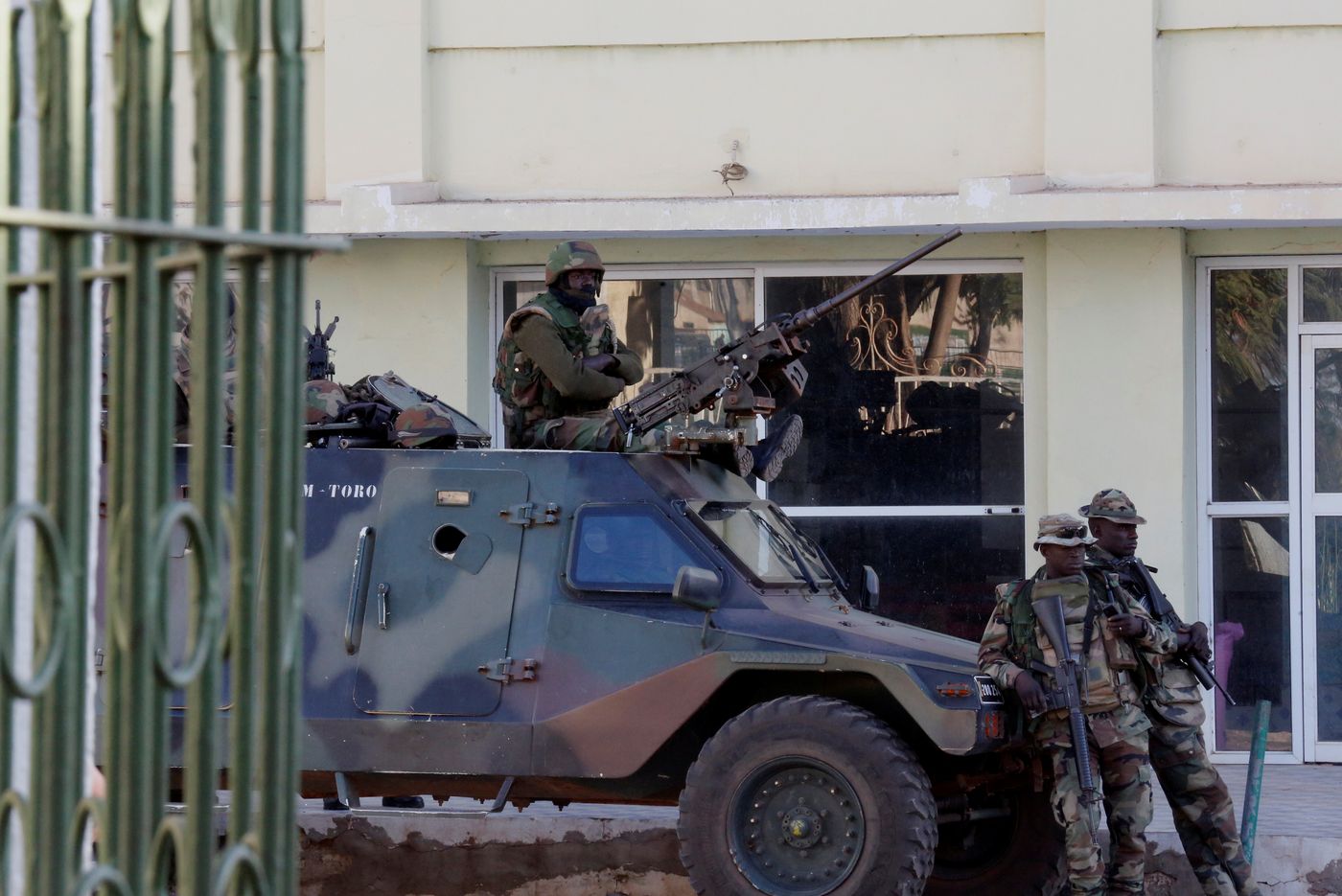
Soldiers from the ongoing ECOWAS Standby Force unit in The Gambia keep guard in front of the presidential palace in Banjul shortly after their deployment, January 23, 2017.
© picture alliance / REUTERS | THIERRY GOUEGNON
Amid the deepest institutional crisis since its inception, the Economic Community of West African States (ECOWAS) is scrambling to remain a relevant security actor in the region. The exit of Burkina Faso, Mali, and Niger from the organization in 2025 and the founding of their own union – the Alliance of Sahel States (AES) – have deeply fractured ECOWAS. It also places the Sahel beyond the reach of ECOWAS peace and security initiatives, while the security crises unfolding in the AES countries continue to spill over into the coastal states. In the absence of decisive action by ECOWAS, the coastal states have self-organized into subregional formats such as the Accra Initiative, albeit with limited success.
However, there is potential for a more robust ECOWAS security role: Following an announcement by the ECOWAS Chiefs of Defence Staff (CDS) in February 2026, a counter-terrorism unit of 1,650 troops (also referred to as an “anti-jihadist” force or an “anti-terror” force by different sources) within the existing ECOWAS Standby Force (ESF) is now expected to take shape. A more proactive regional approach to combating violent extremist groups had been a longstanding demand of Burkina Faso, Mali, and Niger, who cited the absence of such support as one of several reasons for their exit. More than two years after the ECOWAS–Sahel split, the ECOWAS CDS have said that close collaboration with the AES is envisaged for the new unit, although it remains unclear what this might entail.
News of these ambitions by ECOWAS comes amid a period of tentative rapprochement between the Sahel states and the rest of the region. Although this has raised hopes for renewed coordination, major political hurdles remain, particularly in the sensitive areas of security cooperation and intelligence sharing. Moreover, ECOWAS’ ability to operationalize the counter-terrorism unit is severely constrained, raising the risk that it will remain a purely symbolic initiative.
The ESF Faces Deep-Rooted Challenges
Considered a model for other regional standby forces, the ESF has been deployed several times with relative success, including since 2017 in The Gambia. Yet its operational record also highlights a number of recurring challenges. As with many of ECOWAS’ collective instruments, the ESF is activated by coalitions of member states willing and able to commit troops. As a consequence, its deployment often reflects their political agendas, leading to incoherent action. Whereas the recent attempted coup d’état in Benin in December 2025 was countered by the ESF under the leadership of Nigeria, similar political will could not be mobilised in response to the coups in Mali, Burkina Faso, and Niger.
Challenges also exist in the ESF’s technical functioning. In theory, each member state has earmarked units for deployment and is responsible for ensuring their continuous training in accordance with ECOWAS guidelines. In practice, however, member states’ approaches to deployment and training are shaped by domestic political priorities. Training courses at the region’s Training Centres of Excellence, for example, are often used to reward individuals on promising domestic career paths. Consequently, units eventually deployed on ESF missions are not always trained for their mandate – a problem that is particularly acute when highly specialized skills are required, such as in counter-terrorism missions. The ESF also struggles – alongside ECOWAS as a whole – with institutional bottlenecks in Abuja. Joint doctrines and policy frameworks often take years to agree. A Command Post Exercise, which is essential for practising joint operations, was last conducted in 2018. Plans for a renewed edition have since fallen victim to the Secretariat’s lengthy bureaucratic processes. Some member states also pay their contributions to the organization only in part, or not at all, contributing to a lack of financial resources.
Overall, ECOWAS’ structural inertia stands in sharp contrast to the speed, flexibility, and operational responsiveness required to confront violent extremist groups. The envisioned mandate also represents a significant departure from the ESF’s experience with more traditional peacekeeping approaches. This raises doubts about ECOWAS’ ability to develop an effective counter-terrorism unit.
More Questions than Answers on the Counter-Terrorism Unit
The announcement of the counter-terrorism unit’s activation was preceded by lengthy intra-organizational discussions and marred by poor public communication. In spring 2025, Nigeria’s Minister of Defence said that 5,000 troops were envisaged for the unit. A few months later, based on their assessment of what would be necessary to counter the threat effectively, the ECOWAS CDS announced a sweeping 260,000-strong force. During their meeting in Freetown in February 2026, they revised this number down to 1,650 troops in light of the low level of commitment from member states, adding that the force would expand over time.
Although the ESF comprises military, police, and civilian components, interviews with ECOWAS representatives suggest that the envisaged unit would be primarily military in nature. Further details remain vague or classified. For example, according to ECOWAS, key questions such as the circumstances under which the unit would be mobilized and the mechanisms by which the location and scope of its missions would be determined cannot yet be shared with the public.
The organization has estimated that a maximalist version of the unit, equipped with advanced technologies such as Unmanned Aerial Vehicles and AI support for Intelligence, Surveillance, and Reconnaissance work, would cost USD 2.5 billion annually. Without sharing further details on the basis of this calculation, the current 1,650-strong unit is projected to cost USD 410 million annually – roughly equivalent to ECOWAS’ entire annual budget. In background discussions, ECOWAS representatives said that member states aspire to finance the unit themselves rather than mobilize international funding. Some sources read this as a gesture to the AES states, which have accused ECOWAS of being steered by external powers. However, given the strain on many state budgets across the region, this ambition to self-finance casts further doubt on the unit’s near-term activation.
The most concrete step so far is the establishment of a logistics centre for the ESF in Freetown, Sierra Leone, which has also been proposed as the unit’s headquarters. More than 10 years in the making, the depot is reportedly nearing completion and will support the ESF with equipment storage and maintenance. With the mandate of the current ECOWAS Commission under Omar Alieu Touray ending in July 2026, observers consider it unlikely that any decisive steps towards the unit’s further operationalization will be taken before the new Commission has settled in.
Experience with structurally similar subregional mechanisms, such as the now dormant Accra Initiative, illustrates the complexity of the task at hand. In the absence of centralized intelligence-sharing and command structures, and given limited resources, joint action under the Accra Initiative was often ad hoc and narrow in scope, and hence limited in effect. The ECOWAS counter-terrorism unit is likely to face similar challenges, especially as effective missions will depend on cooperation with the AES states.
How Genuine Is ECOWAS’ Olive Branch, and Will AES Accept?
Even in its current undefined shape, the activation of the counter-terrorism unit can be read as a gesture to Bamako, Niamey, and Ouagadougou. Despite public criticism of the AES by ECOWAS Commission President Touray, ECOWAS observers have described the ESF initiative as an olive branch to the Sahel. Indeed, the ECOWAS CDS underlined the need for close coordination with the AES. Sierra Leone’s CDS, Gen. Amara Idara Bangura, reportedly referred to a possible AES association, although this has not been elaborated on publicly.
These commitments to collaboration align with recent ECOWAS and bilateral efforts to improve relations. ECOWAS’ Chief Negotiator with the AES states, Lansana Kouyaté, has been shuttling between capitals, while the presidents of Senegal, Togo, Ghana, and Benin have also been seeking dialogue. This has brought bilateral initiatives such as the reopening of the Niger–Benin border within reach. Yet these advances do not easily translate into regional security cooperation, as long-standing accusations and mistrust persist. ECOWAS heavyweights Côte d’Ivoire and Nigeria, whose financial and troop contributions to the counter-terrorism unit will be decisive for its viability, remain highly sceptical of the Sahelian juntas. Repeated confrontations between Côte d’Ivoire and its northern neighbours – both diplomatic and in the context of counter-insurgency operations – underscore the long road ahead to achieve collaboration on highly sensitive matters such as joint operations and intelligence sharing.
The AES states, meanwhile, have not publicly responded to ECOWAS’ overture. They have also established their own subregional force, the so-called Unified Force, although its operational viability is equally uncertain. While sources in Abuja confirmed that military staff from the Sahel countries regularly exchange with ECOWAS staff at the working level, political signals of interest in security cooperation have so far remained absent.
All in all, these challenging framework conditions suggest that the ESF counter-terrorism unit will likely remain a symbolic force for the foreseeable future. If there is potential for cooperation with the AES, it could materialize in the form of small-scale joint military operations led by willing ECOWAS member states.
Dr Franziska Ehlert-Gorlow is a Project Director of Megatrends Afrika and an Associate in the research division Africa and Middle East at the German Institute for International and Security Affairs (SWP).