The Implementation Gap and Energy Transition Pathways in Africa
Megatrends spotlight 72, 12.06.2026Africa's energy transition will be won or lost in implementation. Botswana and Uganda show that targets matter only when matched by credible procurement, resilient grids, bankable finance and institutions capable of turning ambition into reliable, inclusive and low-carbon power systems.
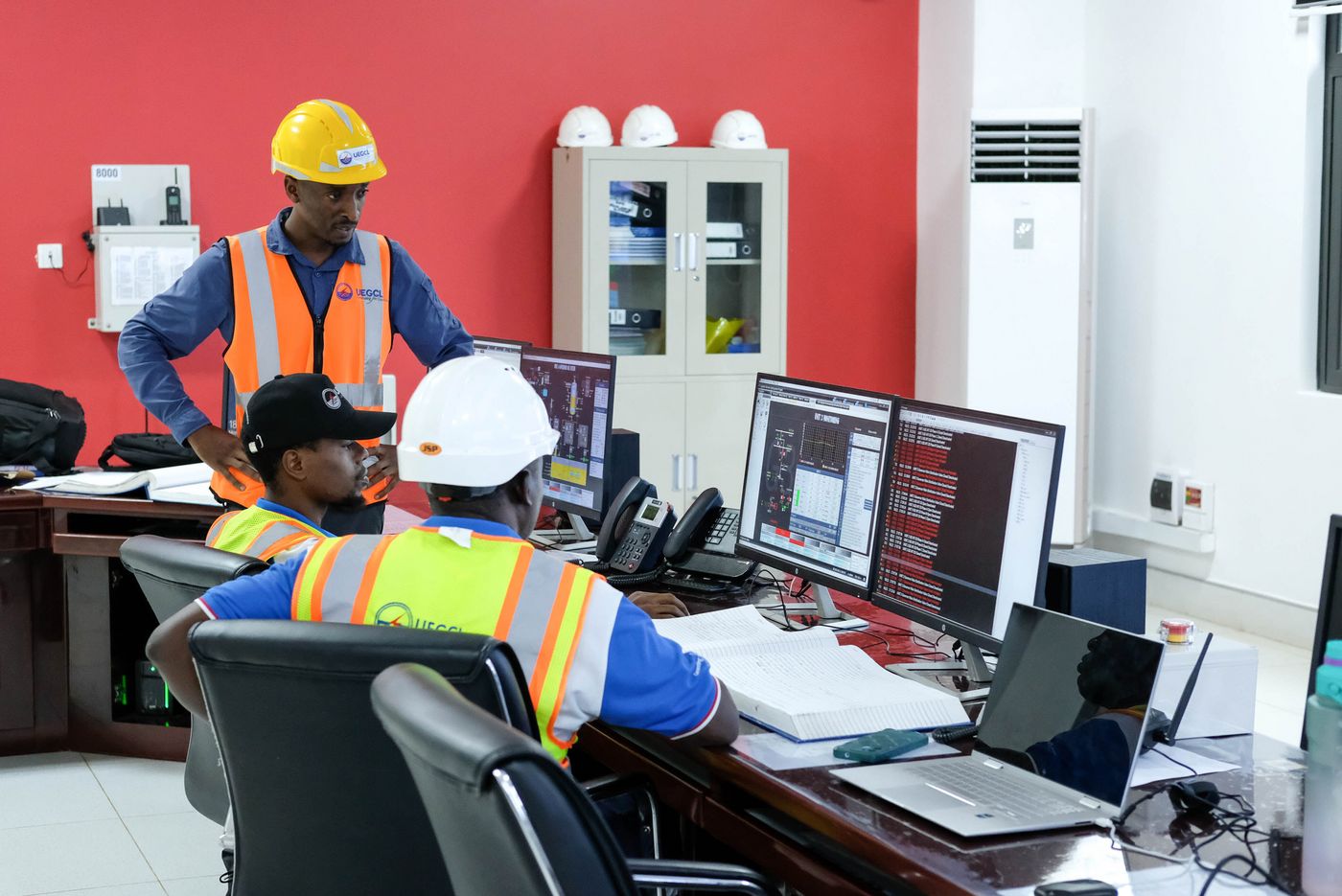
Workers at Karuma Hydropower Plant in Kiryandongo, Uganda, on August 21, 2023.
© picture alliance / Xinhua News Agency | Hajarah Nalwadda
Africa’s energy transition challenge is not only a question of ambition, but also of implementation. It requires delivery systems that can expand electricity access, improve reliability and reduce emissions together. Botswana and Uganda use the language of energy transition, but their power systems reveal a widening implementation gap between commitments on paper and the institutional, procurement and grid conditions needed to deliver them. This matters because, according to data from the International Energy Agency (IEA), sub-Saharan Africa still had 451 million people without electricity in 2023.
Botswana and Uganda sit at opposite ends of the energy transition spectrum. Botswana is a coal-dependent upper-middle-income power system trying to reconcile reliability, building homegrown generation capacity rather than depending on electricity imported from neighbouring countries (“domestic supply ambitions”), and low-carbon commitments. Uganda, by contrast, is largely renewable and hydropower-dominated, so its main challenge is not coal replacement but access, affordability, grid resilience and climate vulnerability.
This contrast makes the comparison analytically useful. Despite their different system structures, both countries face a shared governance problem. Policy ambition has moved faster than the delivery mechanisms needed to turn commitments into projects and system improvements. Financing arrangements, procurement processes, grid investment plans and institutional coordination mechanisms remain incomplete or inconsistent.
Mechanisms Underlying the Implementation Gap
In both Botswana and Uganda, the implementation gap between what governments commit to and what they can deliver is not a single policy failure, but a recurring delivery problem that appears in different system contexts. It operates through three mechanisms. Firstly, targets are announced without being embedded in least-cost planning, tariff policy, procurement schedules and grid investment (transmission lines, substations, transformers and distribution upgrades). Secondly, institutional mandates are fragmented. Ministries, regulators, utilities and finance agencies may all support transition objectives, but their planning cycles, budgetary tools and accountability structures do not always reinforce one another. Thirdly, credibility falters when investors doubt whether tenders, grid connections or utility payments will materialize. That is why citing financing gaps or weak procurement as the main barriers, as donor agencies often do, is insufficient as a full explanation.
Botswana: Heavy Dependence on Coal, Exposure to Power Imports and Slow Project Delivery
Botswana’s transition commitments sit alongside a power system that still runs largely on coal. Botswana’s National Energy Policy commits to energy security and low-carbon development, while its Integrated Resource Plan provides a least-cost pathway with domestic electricity generation, regional imports, demand-side measures, including appliance standards and load management schemes, and reliability requirements. In practice, however, these ambitions must be delivered through a power system still dominated by coal.
The country’s National Energy Compact (2025) makes this tension explicit. It states that around 97 per cent of electricity is generated from coal and that the 600 MW Morupule B plant has continued to underperform. This creates the first commitment gap. Coal dependence reflects a planning system that has not acted on its own commitments — Botswana Power Corporation (BPC) cannot adequately offer investors the guarantees they need.
The second gap lies between Botswana’s energy security ambition and the actual conditions of supply. The National Energy Compact reports that, between 2023 and 2024, electricity imports accounted for about 30 per cent of Botswana’s distributed electricity. These imports came mainly from South Africa’s Electricity Supply Commission and Zambia Electricity Supply Corporation through the Southern African Power Pool. Regional trade in power is not the problem; the problem is that imports are filling a domestic supply gap at the same time as government policy is pointing towards solar expansion. Botswana therefore faces a concrete delivery gap. No competitive solar tender has been issued, grid connection rules for independent producers have not been settled, and BPC has published no procurement timetable. That absence of follow-through is the real expression of the gap between what the Integrated Resource Plan recommends and what has actually happened.
The third gap concerns the conversion of investment needs into projects that are ready for procurement, grid connection and financing. The International Renewable Energy Agency’s Renewables Readiness Assessment puts the investment Botswana needs at roughly USD 18.4 billion to meet its Nationally Determined Contribution (NDC) target of a 15 per cent emissions cut by 2030. Investors need a clear line of sight to revenue — published tender dates, settled grid connection rules and a cost-recovery framework that works. Without these, coal and imports keep the system running, while renewable energy stays at the level of aspiration rather than procurement and renewable policy remains ahead of delivery. As at 2025, none of these conditions exist – no tender timetables, grid connection cost schedules or storage procurement rules have been published.
Uganda: Strong Renewable Generation, but Unresolved Access, Demand and Resilience Challenges
Uganda shows that a transition challenge can persist even when a country is already largely renewable. According to Uganda’s Electricity Regulatory Authority, installed generation capacity reached 2,048.1 MW in the second quarter of 2024. Renewable projects accounted for about 95 per cent of this capacity, but the mix is heavily concentrated on hydropower, which contributed about 84 per cent of installed capacity. Uganda’s NDC targets a 24.7 per cent emissions reduction below business-as-usual by 2030, with most mitigation expected from agriculture and land use. The transition challenge is therefore not mainly fossil fuel replacement. It is whether renewable electricity can support development through reliable supply, affordable access, stronger grids, productive demand and resilience to climate and hydrological shocks.
The first gap in Uganda relates to access. The Energy Policy for Uganda 2023 reports that around 57 per cent of the population has electricity access in some form (grid and off-grid). Urban electricity access exceeds 70 per cent, while rural access was about 42 per cent in 2023. Rural grid access is much lower, at around 9 per cent, so many households rely on off-grid solar power or use electricity mainly for lighting. The Free Electricity Connection Policy was introduced in 2018 to reduce the upfront cost of electricity connections for households and small enterprises. The government committed to waiving household connection fees and covering last-mile infrastructure costs. This addressed a major access barrier, especially where connection fees can equal two or three months of household income. Roll-out has stalled because budgets have not matched commitments and distribution networks are too weak.
The second gap concerns reliability. Uganda’s hydropower output depends on rainfall, river flows and the lines connecting dams to consumers. The 600 MW Karuma plant, commissioned in 2024, substantially boosted capacity, but its troubled delivery showed how large projects can go wrong. Power investments can face delivery risks. Reuters reported long delays and a system disturbance during testing before commissioning. The issue is therefore not hydropower itself, but whether Uganda has enough grid flexibility, backup options and climate-aware planning to keep power reliable when conditions change. Uganda lacks adequate reserve capacity. The Karuma delays left a gap of more than 400 MW in dispatchable power, and links with Kenya and Tanzania run below rated capacity. Without flexible backup, the system is exposed to drought-driven losses like those of 2016–2017.
The third gap is in turning a supportive regulatory environment into reliable procurement and delivery. Instruments such as the Uganda Renewable Energy Feed-in Tariff Guidelines can make investment more predictable for smaller renewable developers. Under the scheme, Uganda Electricity Transmission Company Limited, the national transmission utility and single bulk buyer, purchases power from eligible small hydro, biomass and solar projects at fixed prices. This gives developers some revenue certainty. However, a guaranteed purchase price does not by itself ensure regular procurement, affordable grid connections or timely payments by the utility. The real challenge is getting megawatts to the people who need them. Without this, additional renewable capacity may improve supply on paper while leaving access, affordability and productive use unresolved. A last-mile fund drawing on the national budget and climate finance would reach households that cannot pay upfront. Partial credit guarantees would shift the non-payment risk from private investors.
Comparative Insight and Recommendations
Botswana’s challenge is primarily one of decarbonization. Its power system remains structurally dependent on coal, constrained by persistent plant underperformance and increasingly reliant on electricity imports, leaving the transition slow and uneven. The core challenge in Uganda is not power sector decarbonization, but expanding reliable access, strengthening climate resilience and stimulating electricity demand in a system that is already largely renewable.
The comparative insight is that African energy transition policy should not be judged only by the carbon intensity of installed generation. A low-carbon power mix does not automatically mean a successful transition, just as high renewable potential does not guarantee delivery. What matters is whether planning, finance, procurement, grid expansion and utility governance are aligned with the country’s actual bottleneck.
Three policy priorities follow. Firstly, NDC commitments must be embedded in power sector planning. Botswana should translate targets into procurement, storage and grid upgrades, while Uganda should prioritize resilience, access and productive use. Secondly, clean power procurement must become credible through transparent timetables, bankable contracts, grid connection plans and financially viable utilities. Thirdly, Germany, the European Union and other partners should finance specific delivery gaps, including coal-region transition and grid integration in Botswana, and last-mile access, mini-grids, distribution and affordability in Uganda.
Benard Musekese Wabukala is a Senior Lecturer, Makerere University Business School, Kampala, Uganda, and Research Fellow at the African Institute for Sustainable Energy and Systems Analysis (AISESA) in Dakar, Senegal.
Dr Phemelo Tamasiga is an Associate at Megatrends Afrika and a Researcher at the German Institute of Development and Sustainability (IDOS).