The Weaponization of Social Media in Sudan’s War
Megatrends spotlight 70, 23.04.2026In Sudan’s war, social media has become a central battlefield, where influencers from the diaspora shape narratives, legitimize violence, and deepen polarization. Onor Hamad explains how lines between media and military roles are being blurred, and calls for stronger regulation and accountability.
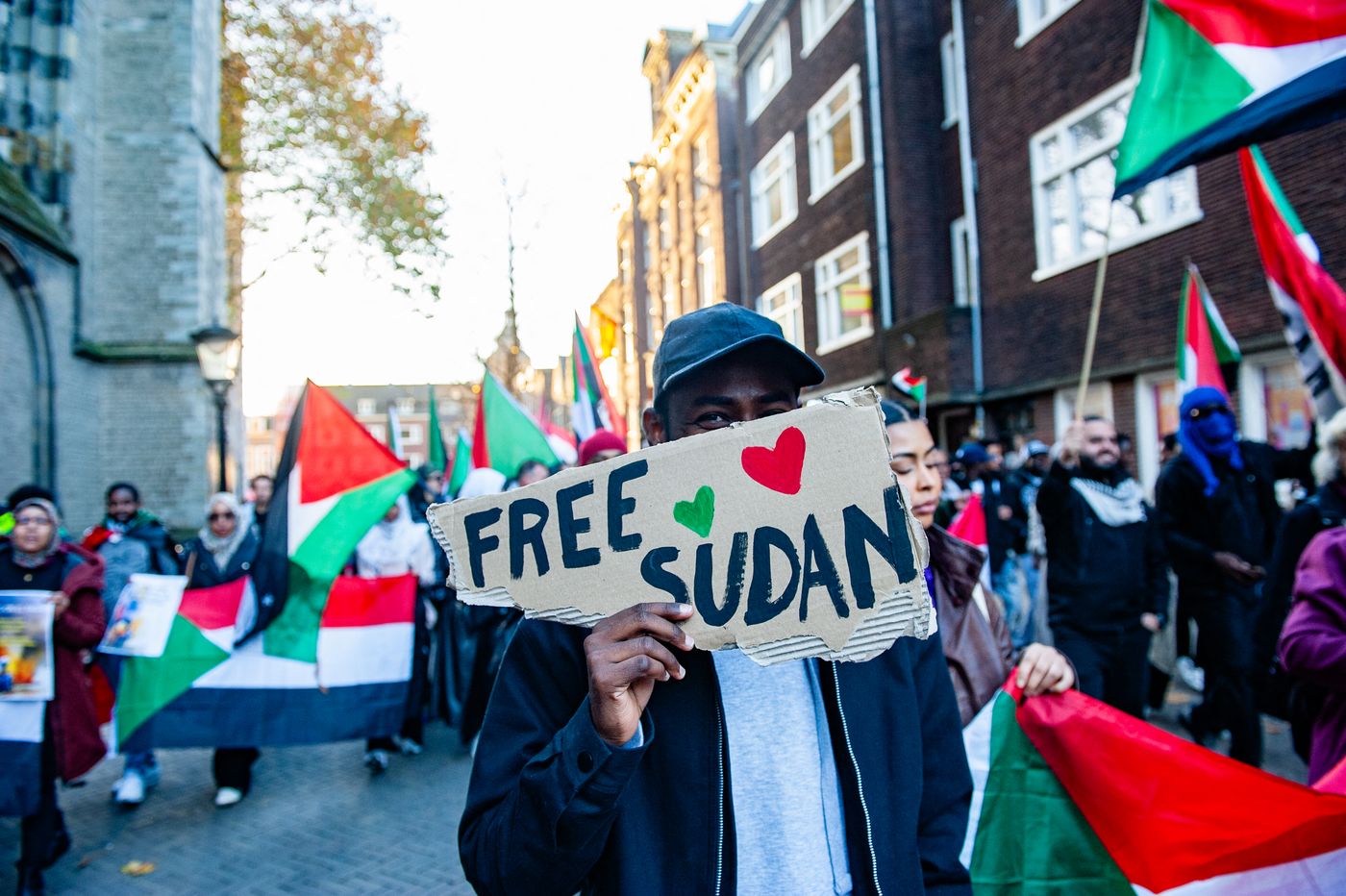
Pictures of demonstrations such as this one in Utrecht, the Netherlands, on 9 November 2025 are often used and reframed as 'anti-Sudan protests' in order to manipulate public opinion in Sudan and delegitimise the voices of the diaspora in civil society abroad.
© ROMY ARROYO FERNANDEZ / NURPHOTO / NURPHOTO VIA AFP
Since the outbreak of the war in Sudan in April 2023, analysts have increasingly recognized that the conflict extends far beyond conventional military confrontation. As a 2025 analysis on digital propaganda in Sudan shows, the war has unfolded simultaneously on various social media platforms, where competing actors deploy influence tactics, disinformation, and coordinated messaging to shape public perceptions and political outcomes. Building on the 2025 analysis, this article argues that the digital sphere has evolved into a central operational environment, actively shaping the conflict’s political and security trajectories rather than merely reflecting them.
Social Media Accounts (Re)Producing War Narratives
An examination of Sudanese war-related content reveals that social media has become a space in which war narratives are constructed and amplified. More than 50 active accounts consistently reshape battlefield developments in ways that serve either the Rapid Support Forces (RSF) or the Sudan Armed Forces (SAF). This analysis draws on a sample of accounts to illustrate how selective framing, exaggeration, and political messaging combine to create persuasive yet polarizing narratives.
When hate speech, pro‑war messaging, or separatist ideas circulate online, they do not fall on empty ground. Rather, they resonate with old grievances and tensions in the community, deepening social fragmentation. Influencers involved in Sudan’s war narratives focus heavily on long-standing social, political, and cultural conflicts with deep historical roots. They link the current war to older struggles dating back to the colonial period, use emotional language, often in Sudanese dialect, and reduce complex issues into simple, polarizing stories. As a result, Sudanese audiences have shifted from being passive consumers to active participants in producing, amplifying, and legitimizing these narratives.
Escalating the Conflict
Influencers on TikTok and Facebook play a key role in reinforcing and amplifying war narratives. Through celebratory posts, livestreamed commentaries, and emotionally charged content, they sustain mobilization and normalize violence. Their messaging not only maintains the momentum, but also helps justify abuses and blur the boundary between civilian discourse and military propaganda.
Accounts aligned with the RSF illustrate this dynamic. One TikTok account which this text will refer to as “K. D.”has around 655,000 followers. K. D. is believed to be based in Saudi Arabia or another Gulf country, although he has appeared in videos from East Africa. He also maintains ties to RSF-affiliated groups known as Imbagha and promotes war while justifying killing under the slogan of fighting “Islamists”. Another account “A.K.” has around 102,000 followers on TikTok. Operating from France, A.K. is another controversial figure known for spreading hate speech and exerting strong influence within RSF circles.
Among accounts that side with the SAF, one of the largest is the Facebook account of Al-Insirafi. Working as a political activist under this pseudonym, he became famous during the 2019 December revolution that overthrew Omar al-Bashir’s rule. Although his real identity and place of residence remain unknown – with some speculating that a group is behind the account – his videos are voiced by the same individual. Over time, his platform recorded more than 45 million views on YouTube and built a large following on X, TikTok, and Facebook because of the information it shared with the public. His name later became a well-known reference point in the information space, despite frequent accusations of hate speech and legal threats against him. Another influencer is K. A., who has some 354,000 followers on TikTok. K. A. is based in Canada and, while supporting the SAF side, has appeared in TikTok livestreams with RSF members. This apparent contradiction reflects his enormous fame, even among RSF fighters, and the collective hype around him. Appearing in his livestreams is seen as something to boast about. In some livestreams, he was able to speak with RSF teenage fighters, trying to get information on the weapons used or the fighters’ current locations to share later. He is believed to coordinate with military intelligence and security services and may have links to Sudanese embassies abroad. Finally, the TikTok account of B., which has some 1.6 million followers, is another influential voice. Operating from France, he uses his account to encourage mobilization and fighting in support of the SAF.
Engaging in the Conflict
Another significant development regarding influencers is their direct interaction with fighters on the ground through frequent livestreams. R. A. A., who is reportedly Somali and believed to live in a European country, gained broad attention during the war, reaching around 281,000 followers. She appeared in multiple TikTok livestreams with RSF field commanders such as General Abu Judood and General Kushib, the son of a man convicted of war crimes in The Hague. Her content celebrates RSF victories, encourages the continuation of the war, and justifies RSF abuses. According to followers, she was also seen in Kampala, and reports circulated that RSF commanders arrested in Chad had allegedly planned to meet her. In addition, the TikTok account M. B. serves as a key media voice for the RSF and for the Ta’sis Alliance community. He relies on sources within the forces to share military and political information and is part of coordinated media rooms that shape and promote the RSF war narrative.
These encounters are not neutral media engagements, but carry messages of support and motivation, demonstrating the ability of influencers to reach armed actors. Livestreaming on TikTok with fighters has become a performative display of influence, where the ability to host combatants in real time signals the account owner’s status, reach, and perceived power. These accounts are not only broadcasting the war, but also fighting their own parallel battles, competing for dominance through joint livestreams that often attract some 5,000 viewers, and sometimes more. In these sessions, figures such as ABR, who supports the SAF from Canada, may host pro-RSF platforms alongside other large accounts aligned with both sides of the conflict, creating a volatile arena marked by insults, verbal attacks, and explicit hate speech. Much of this discourse is conducted in Sudanese colloquial Arabic as a deliberate tactic to evade platform moderation and exploit linguistic blind spots.
Moreover, these influencers not only engage with armed actors, but also influence them. One notable case involves M. B., a pro-RSF influencer who publicly called for the removal of a specific RSF commander in an area of Kordofan, accusing him of corruption and lack of courage. The message was directed explicitly to RSF leader Mohamed Hamdan Dagalo. What makes this case significant is that the influencer lives in the Netherlands, yet his platform has substantial influence inside Sudan. According to our analysis, this individual maintains direct communication with soldiers and field operatives, who supply him with information and complaints. The fighters often turn to influential online voices when they fail to resolve issues through official military channels.
Normalizing Violence
One of the most dangerous consequences of this development is the normalization of violence. Livestreams and videos documenting killing, humiliation, or other violations are often presented in celebratory, competitive, or threatening ways, dehumanizing victims and rendering violence ordinary and socially permissible.
This use has been particularly evident in RSF documentation of its violations. Recorded videos and livestreams have also emerged documenting violations by SAF factions, specifically jihadist elements, underscoring the use of media as a psychological weapon for intimidation, mobilization, and the celebration of victory and killing. In the absence of sufficient media literacy, this content contributes to a shift in ethical standards, especially among younger generations, and fosters growing social acceptance of documented violence.
Repressing Anti-War Voices
Another aim is the delegitimization and intimidation of civil society. Some influencers not only promote war narratives but deliberately circulate images, information, and statements about activists and political figures who call for an end to the war or criticize the warring parties. Oftentimes, pictures of real demonstrations outside Sudan are reframed as “Anti-Sudan protests” initiated by Europe or Israel to manipulate public opinion in Sudan. In this way, civilian revolutionary forces – an important part of the anti-war public voice – are portrayed as traitors or foreign agents. This process of delegitimization serves to silence dissent, discredit civilian alternatives, and reinforce the narrative that war is both justified and unavoidable. Moreover, numerous videos of brutal killings such as beheadings and burnings are circulated as warnings and tools of intimidation by warring parties, including jihadist factions within the SAF and elements of the RSF. During these acts, perpetrators chanted phrases directed at specific individuals and groups within both the army and the RSF. This illustrates the extent to which both sides rely on social media platforms in managing the war.
Conclusion: A New Arena of War and a New Set of Actors
The Sudanese case demonstrates that modern warfare is no longer waged by weapons alone – social media platforms now play an increasingly important role. Social media accounts are key tools for managing war narratives and extending the conflict beyond the battlefield. Platforms such as TikTok and Facebook have become integral to the Sudanese conflict.
In addition, the analysed accounts reflect two actor-centred developments. First, they illustrate a qualitative shift in the role of the media influencer, from a transmitter of events to an active participant in the conflict environment. Second, they show that individuals operating from outside the country have become powerful actors in the war, using social media to spread information, influence emotions, legitimize violence, spread hate speech, and deepen social polarization. As this pattern is repeated, the boundaries between media and military action erode, raising legal and ethical questions about the role of social media in armed conflicts.
Accordingly, addressing this reality requires moving beyond viewing digital media as a marginal or merely reflective element of conflict and recognizing it as a new arena. This calls for stronger regulatory and oversight policies, independent monitoring, and genuine accountability regarding the role of individual users, platform providers, and host countries in transnational armed conflicts.
Onor Hamad is a Sudanese journalist and political activist whose work bridges advocacy and narrative. Deeply committed to Sudan’s democratic transition, he has collaborated with grassroots movements, civil society organizations, and youth networks to promote nonviolent resistance and civic engagement. He is currently a resident scholar of the Elisabeth-Selbert-Initiative in Berlin, hosted by the r0g_agency for open culture and critical transformation.
The responsibility for the content, opinions and sources presented in the articles and interviews lies with the respective authors.
